

Summary
The Cost of Blind Spots in Explosive Atmospheres
The UAE Hazardous Zone Reality — Where Standard Cameras Fail
PTZ in Hazardous Zones — The 360° Operational Advantage
IR Capability — Why Night Vision Is Non-Negotiable in UAE Hazardous Sites
ATEX Certification — The Compliance Standard UAE Managers Cannot Ignore
SharpEagle Explosion Proof PTZ Cameras — Built for UAE Conditions
Real-World Application Scenarios in the UAE
Conclusion
Summary
UAE hazardous industries operating in Zone 1 and Zone 2 environments cannot afford surveillance blind spots. Explosion-proof PTZ cameras combine 360-degree mobility, integrated IR night vision, and ATEX/IECEx certification to deliver uncompromised safety coverage across oil and gas, petrochemical, and industrial facilities. Unlike fixed cameras, PTZ units eliminate blind spots, reduce infrastructure costs, and allow remote operation without zone-entry risk. This blog covers PTZ advantages, IR requirements, ATEX compliance essentials, real-world UAE applications, and how SharpEagle delivers locally supported, purpose-built solutions.
The Cost of Blind Spots in Explosive Atmospheres
The GCC region records thousands of reportable hazardous zone safety events every year, and inadequate monitoring consistently appears as a contributing factor. Yet a significant share of UAE facilities running 24/7 operations in Zone 1 and Zone 2 atmospheres still rely on fixed-angle cameras, creating blind spots that no operator dashboard can compensate for.
A fixed explosion-proof camera UAE facilities depend on today cannot pivot to track a leak plume, follow a contractor entering an exclusion zone, or capture a vehicle approaching from an adjacent angle. That single limitation can be the difference between early intervention and a major incident.
This is where the explosion-proof PTZ camera UAE category steps in, eliminating blind spots without multiplying infrastructure costs. This article covers PTZ advantages, ATEX compliance, IR capability, and what SharpEagle delivers for UAE industrial facilities.
The UAE Hazardous Zone Reality — Where Standard Cameras Fail
Several UAE sectors make explosion-proof security cameras a regulatory obligation, not just best practice. Onshore and offshore oil and gas platforms, including ADNOC concession areas, Das Island, and active offshore rigs, sit at the top of the demand curve for an ATEX PTZ camera in Abu Dhabi. Petrochemical processing and LNG facilities at Ruwais and Jebel Ali follow closely. Chemical storage, solvent blending, and paint manufacturing warehouses in Sharjah and Dubai Industrial City carry equally high risk profiles, as do power generation plants operated by DEWA and ADDC.
Zone 1 means flammable gas is present under normal operating conditions. Zone 2 means gas appears only under abnormal conditions. Zone 21 and Zone 22 apply to combustible dust environments. Every classification requires certified equipment, and standard IP cameras are prohibited.
The UAE climate adds complexity that temperate markets do not face. Temperatures regularly exceed 50°C, coastal salt spray accelerates corrosion, and Shamal dust storms degrade unprotected equipment within a single season. Choosing the wrong industrial explosion-proof camera here is both a compliance failure and a reliability failure.
PTZ in Hazardous Zones — The 360° Operational Advantage
PTZ stands for Pan, Tilt, and Zoom. The pan covers horizontal rotation up to 360 degrees; the tilt handles vertical movement up to 90 degrees; and the zoom delivers optical magnification up to 36x without resolution loss. One camera, effectively infinite angles, controlled entirely from the safety of a control room.
A single explosion-proof PTZ camera UAE deployment with 30x optical zoom replaces five to seven fixed units across a 200-meter refinery segment, significantly reducing installation complexity and maintenance exposure in Zone 1 areas.
In hazardous zones, physically adjusting a fixed camera requires a permit-to-work, PPE compliance, and formal zone-entry authorization. With an explosion-proof IP camera equipped with PTZ functionality, operators redirect coverage instantly from the DCS or SCADA control room. A second explosion-proof IP camera is rarely needed when one PTZ unit covers the same ground. No personnel enter the zone, and there is no delay.
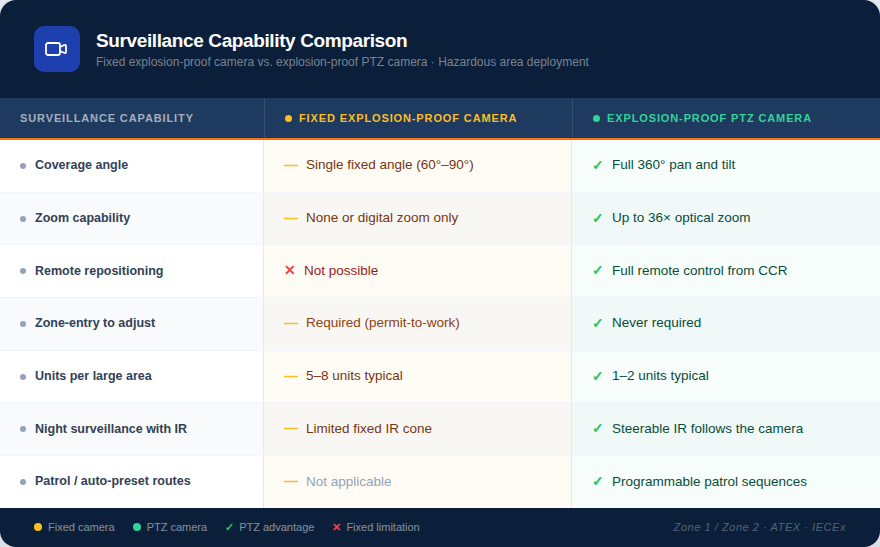 Programmable patrol routes remove the human error variable from night shift monitoring, ensuring no coverage gaps during off-peak hours or reduced staffing periods.
IR Capability — Why Night Vision Is Non-Negotiable in UAE Hazardous Sites
Facilities at Ruwais, Das Island, and Jebel Ali Free Zone operate around the clock. Hazardous zones within these sites are often minimally lit, and a camera dependent on ambient light becomes operationally blind after sunset. That is simply not acceptable at a facility processing flammable materials.
An explosion-proof PTZ camera with IR resolves this directly. Active infrared illumination built into the certified housing produces clear imagery between 100 meters and 300 meters in total darkness, without requiring external light sources that carry their own ignition risk.
Standard IR cameras with exposed LED arrays are prohibited in ATEX zones because the driver circuitry can generate sparks. Every component of the IR illuminator must be certified as part of the ATEX-rated enclosure. Specifying a genuine explosion-proof PTZ camera with IR in your RFQ closes this loophole before it becomes a liability on site.
For procurement teams, require a 100-meter IR range minimum for internal zone monitoring, 200 meters for external perimeters and tank farms, and 300 meters for large open refinery yards. Including these figures in your RFQ ensures suppliers deliver a compliant explosion-proof PTZ camera with IR rather than a substandard alternative.
ATEX Certification — The Compliance Standard UAE Managers Cannot Ignore
ATEX governs equipment in explosive atmospheres and has been adopted across UAE procurement standards by ADNOC, DEWA, and major EPC contractors. IECEx is the international equivalent, often mandated specifically by UAE site authorities. Holding ATEX does not automatically satisfy IECEx. Buyers must confirm which standard their site authority demands before ordering any ATEX certified PTZ camera.
Three protection concepts apply to PTZ-certified cameras. Ex d, a flameproof enclosure, contains any internal ignition so it cannot reach the surrounding atmosphere. Ex e, increased safety, eliminates ignition sources through design. Ex i, intrinsic safety, limits electrical energy below the ignition threshold under all fault conditions.
Always verify an ATEX PTZ camera supplier's certificate number. A photocopy is not sufficient in a UAE regulatory audit. Deploying non-certified hazardous area PTZ cameras exposes organizations to HSE prosecution, contract penalties, insurance voidance, and significant personal and corporate liability.
SharpEagle Explosion Proof PTZ Cameras — Built for UAE Conditions
SharpEagle is a specialist in ATEX explosion-proof CCTV and industrial safety, not a generalist security supplier. That distinction matters to operations managers who have experienced the cost of unsuitable products from vendors without genuine hazardous area expertise.
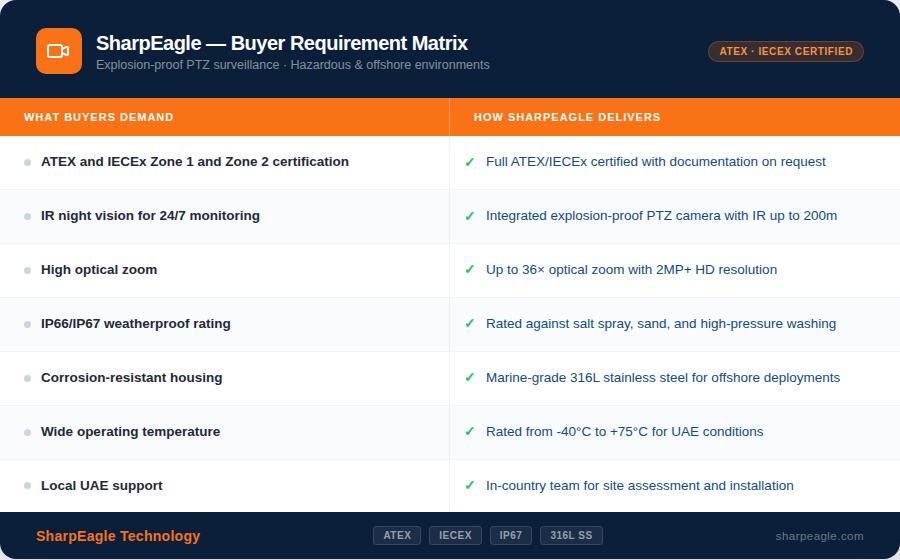 SharpEagle also provides a full range of forklift safety solutions, making it a complete industrial safety partner across surveillance and vehicle safety applications.
Real-World Application Scenarios in the UAE
Offshore Oil Platform, Abu Dhabi: A single explosion-proof PTZ camera with 30x zoom replaces six fixed units, monitoring drilling decks, the helipad, and loading zones continuously through programmed patrol presets.
Chemical Storage Facility, Jebel Ali Free Zone: An explosion-proof camera Dubai specification rated ATEX Zone 1 tracks tanker movements in real time, allowing the control room to redirect focus during nighttime deliveries without deploying personnel into the hazardous area.
Petrochemical Plant Perimeter, Ruwais: Long-range IR PTZ cameras with explosion-proof housing monitor an 800-meter perimeter fence line, detecting unauthorized access in complete darkness while meeting ADNOC compliance requirements.
Solvent Manufacturing Warehouse, Sharjah: Intrinsically safe PTZ cameras with Zone 21 dust-zone certification provide full coverage inside raw material storage areas, removing the need for on-site patrols in dangerous zones entirely.
Conclusion
In UAE hazardous industrial environments, the question is no longer whether to use explosion-proof cameras. It is a choice between accepting the limitations of fixed units or moving to PTZ surveillance that adapts in real time without exposing personnel to zone-entry risk.
Three pillars define the case. PTZ mobility eliminates the blind spots fixed cameras leave unaddressed. Integrated IR delivers uncompromised 24/7 surveillance in total darkness. ATEX and IECEx certification are the non-negotiable baselines for UAE regulatory compliance.
SharpEagle brings all three together in a single, locally supported solution. Contact us today to speak with a UAE safety specialist, request a free site assessment, or download a product brochure. SharpEagle delivers explosion-proof PTZ camera solutions across the UAE, Saudi Arabia, Oman, Kuwait, Bahrain, and Qatar, with operations expanding globally.