

Summary
Introduction
Why Forklift Reversing Accidents Are a Major Safety Concern in UAE Facilities
What Is a Forklift Reverse Sensor System?
Why UAE Warehouses Need Forklift Reverse Sensor Systems
- Extreme Operational Activity
- High Pedestrian Traffic
- Congested Loading Areas
- Dusty Industrial Conditions
- 24/7 Operations
- Safety Compliance Requirements
Key Features to Look for When Buying a Forklift Reverse Sensor System
- Radar Based Detection
- Multi Zone Warning System
- Long Detection Range
- Visual and Audible Alerts
- False Alarm Reduction
- All Weather Performance
- IP69K Protection
- Easy Retrofit Installation
Forklift Reverse Sensor Technologies Compared
Why SharpEagle Forklift Reverse Sensor Systems Stand Out
Applications Across UAE Industries
- Warehouses and Distribution Centres
- Ports and Container Terminals
- Manufacturing Plants
- Cold Storage Facilities
- FMCG Warehouses
- Construction Material Yards
Operational Benefits for UAE Facility Managers
Common Mistakes to Avoid When Buying a Reverse Sensor System
Future Trends in Forklift Collision Avoidance Technology
Conclusion
Talk to SharpEagle About Forklift Reverse Sensor Systems
Summary
UAE warehouses face rising forklift traffic and collision risks. This guide explains how a forklift reverse sensor system works, why radar based detection outperforms ultrasonic and camera systems, and what features facility managers should prioritize, helping UAE businesses choose safer, more reliable warehouse solutions.
Introduction
Anyone who has spent time around a busy UAE distribution centre knows how fast things move. JAFZA, Khalifa Port, Abu Dhabi Industrial City, Dubai Industrial City and the manufacturing hubs around Sharjah have all expanded so quickly over the last few years that forklift traffic has practically doubled in some facilities. More forklifts moving more often means more chances for something to go wrong, and that's exactly why collision prevention keeps coming up as a top priority for warehouse managers right now.
Here's the thing about warehouses: they're crowded by design. Reversing forklifts share the same floor space as pedestrians, racking, loading bays, and other vehicles, often with only a few seconds of warning before a near miss turns into something worse. A reverse sensor for forklift fleets gives operators that extra bit of awareness they wouldn't otherwise have, flagging what's behind them before it becomes a problem.
It makes sense, then, that more UAE facilities are investing in forklift safety solutions UAE wide. It's not just about ticking a compliance box. It genuinely changes how safe a warehouse floor feels day to day, and it tends to pay for itself once you factor in fewer incidents and less downtime.
This guide covers what you actually need to know before buying a forklift reverse sensor system UAE businesses can rely on, including how it works, what features actually matter, and where people tend to go wrong when choosing one. At the end of the day this comes down to picking the right reverse sensor for forklift fleets that face real UAE conditions every day.
Why Forklift Reversing Accidents Are a Major Safety Concern in UAE Facilities
Ask any warehouse supervisor which forklift manoeuvre worries them most, and reversing usually comes up first. It's not hard to see why. Operators reversing a loaded forklift often can't see much behind them, and in a lot of warehouse layouts, that blind spot lines up almost perfectly with where people walk.
A few things tend to show up again and again when you look at why these accidents happen:
- Blind spots created by mast height or stacked pallets
- Pedestrian crossings that cut straight through forklift routes
- Narrow aisles that don't leave much room to correct a mistake
- Loading docks that get congested during shift changes
- Dust, glare, or weak lighting that makes visibility worse
- Long multi shift schedules where tired operators misjudge familiar routes
None of this is limited to one type of business either. Warehousing, logistics, ports, manufacturing, FMCG, and cold storage all deal with the same basic problem, just in slightly different settings.
And the fallout from a reversing accident rarely stays small. There's the property damage to racking or stock, the injury risk to whoever was in the way, the downtime while everyone figures out what happened, the insurance costs that follow, and the productivity hit that comes with all of it. Once you add that up, it's pretty clear why a forklift accident prevention system stopped being a nice to have and became something most serious operators just expect to have in place.
Read More : Top Forklift Lighting Solutions Providers in the UAE
What Is a Forklift Reverse Sensor System?
Put simply, a forklift reverse sensor system UAE facilities use works by detecting pedestrians, vehicles, obstacles, and warehouse equipment within a set zone behind the forklift, using radar to do the heavy lifting. It's a bit like the parking sensors in a car, except built for the kind of punishment an industrial environment throws at it.
In practice, it works like this. Radar mounted on the back of the forklift keeps scanning the area behind it while the vehicle is in use. The moment it picks up something moving or stationary within range, it works out how far away that object is. As the distance shrinks, the system sends a visual warning to the operator and triggers an audible alarm. Get closer still, and the alerts get louder or more frequent, basically nudging the driver to slow down before things get dicey.
Most systems on the market rely on 24GHz radar technology, which holds up well no matter what the lighting looks like, and this is really what separates a true forklift reverse radar sensor from a basic ultrasonic add-on. Quite a few also use three zone detection, splitting the space behind the forklift into safe, caution, and danger zones, with real time warnings updating as the situation changes. This is essentially a forklift proximity warning system at its core, and SharpEagle builds its forklift safety solutions UAE clients trust around this exact setup, pairing solid radar performance with alerts that operators can actually react to in time.
Why UAE Warehouses Need Forklift Reverse Sensor Systems
Extreme Operational Activity
Logistics facilities across Dubai, Abu Dhabi, and Sharjah don't really slow down. Forklifts are reversing constantly throughout a shift, and that constant repetition is exactly what turns a small lapse in attention into an actual collision, which is why a forklift collision avoidance system UAE wide tends to earn its cost back fast in busy operations.
High Pedestrian Traffic
Warehouse floors are never just forklifts. Workers pulling stock, supervisors doing rounds, and the occasional visitor walking through, all of them cross forklift paths at some point, often without much warning, which is exactly the situation a forklift pedestrian safety system is built to handle.
Congested Loading Areas
Loading bays and container yards tend to be the messiest parts of any facility. Several vehicles moving at once, goods stacked everywhere, and barely enough room to manoeuvre. It's a recipe for higher than average risk.
Dusty Industrial Conditions
Dust and sand are just part of life in the UAE, and they can mess with sensor reliability if you're not careful. Radar based systems generally shrug this off, whereas camera only setups struggle once visibility drops.
24/7 Operations
A lot of warehouses here run around the clock to keep up with demand. That means safety equipment needs to hold up just as well at 3am as it does at midday, shift after shift.
Safety Compliance Requirements
On top of the obvious safety benefits, having a forklift detection system UAE wide in place also supports broader workplace risk reduction efforts, which helps when it's time to show regulators or insurers that safety is being taken seriously. Facilities that delay installing a forklift detection system UAE inspectors would approve of often end up paying more after an incident than they would have spent upfront.
Key Features to Look for When Buying a Forklift Reverse Sensor System
Radar Based Detection
Radar based detection generally holds up better than basic ultrasonic sensors, especially once dust, heat, and vibration get thrown into the mix. At its heart, this is a radar forklift safety system, and that distinction matters more than people realise when comparing options.
Multi Zone Warning System
Look for a setup that splits detection into a Safe Zone, a Caution Zone, and a Danger Zone. That way operators get a graduated warning instead of one sudden alarm right when it's almost too late.
Long Detection Range
A detection range of up to 30 metres gives operators real time to react, which matters a lot more in big warehouses or open yards than it might in a tight indoor space. A forklift reverse radar sensor with this kind of range tends to outperform shorter range alternatives by a wide margin, and it remains one of the better arguments for choosing a reverse sensor for forklift fleets over older detection methods.
Visual and Audible Alerts
You want both visual and audible alerts working together as part of any decent forklift proximity warning system. In a noisy warehouse, a flashing light alone might get missed, and the same goes for a beep that gets drowned out by machinery.
False Alarm Reduction
Smart filtering helps the system tell the difference between an actual obstacle and harmless background movement. Without that, operators tend to start tuning out the alarms altogether, which defeats the whole point.
All Weather Performance
Given the climate here, all weather performance isn't optional if the forklift spends any time outdoors, whether that's a loading dock or an open storage yard.
IP69K Protection
IP69K protection means the sensor can take dust ingress and high pressure washdowns without flinching, which matters a lot in cold storage and food handling facilities.
Easy Retrofit Installation
And finally, easy retrofit installation is worth checking for if you're upgrading an existing fleet rather than buying new forklifts outright. It saves a lot of money and hassle, and it's one of the more overlooked items on any forklift safety equipment UAE checklist.
Forklift Reverse Sensor Technologies Compared
Looking at this side by side, it's easy to see why radar consistently outperforms the alternatives in this climate.
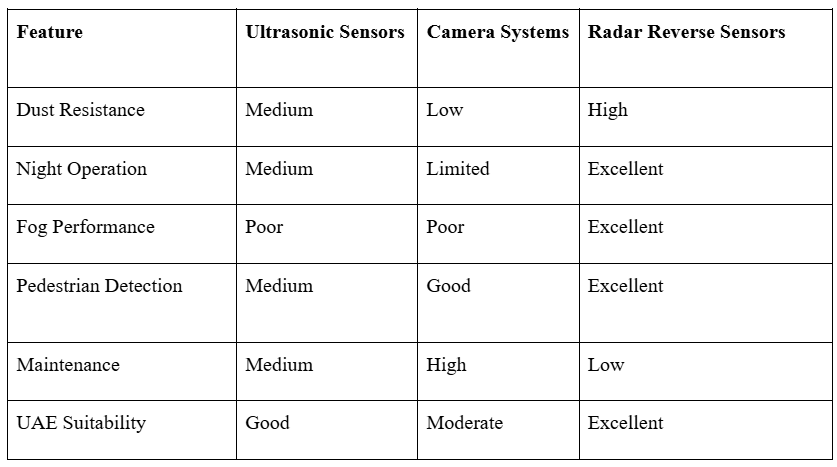 This comparison system built on radar keeps winning out over the alternatives and why so many facilities now treat a forklift collision avoidance system UAE wide as standard equipment rather than an upgrade. Ultrasonic and camera systems aren't useless by any means, they just tend to fall short once you factor in the heat, dust, and long operating hours typical of facilities here. For anyone weighing forklift safety products UAE wide, this table alone tends to settle the decision.
Read More : AI Forklift CCTV Solutions: A Complete Guide to Intelligent Warehouse Safety
Why SharpEagle Forklift Reverse Sensor Systems Stand Out
SharpEagle has built a solid reputation as an industrial forklift safety UAE specialist with real experience across regional warehouses, not just a vendor selling generic hardware. As a radar forklift safety system provider, their lineup of forklift radar detection system hardware is designed around the exact challenges covered earlier in this guide.
On the technical side, you're looking at 24GHz FMCW radar for accurate detection, a range of up to 30 metres, three zone warning for graduated alerts, and IP69K protection for facilities that need genuine durability. These are the kind of forklift safety solutions UAE buyers should expect as a baseline, not a premium add-on. The systems also use CAN-Bus communication so they integrate cleanly with a forklift's existing electronics, and the sensor design stays compact enough that it doesn't get in the way of normal operation. They're built to keep performing across the kind of extreme temperatures this region is known for.
Operators get clear visual and audible alerts, and fleet managers get the benefit of retrofit installation, meaning the system can go straight onto forklifts already in use rather than forcing a fleet replacement. Put together, it's a solid pick for anyone after a dependable forklift collision avoidance system UAE wide, and it doubles as one of the more capable forklift warning system UAE options on the market right now.
Applications Across UAE Industries
Warehouses and Distribution Centres
Warehouses and distribution centres across Dubai, Abu Dhabi, and Sharjah see some of the heaviest forklift traffic in the country, which is exactly where this kind of detection earns its keep as a genuine warehouse forklift safety UAE asset.
Ports and Container Terminals
At places like Jebel Ali Port and Khalifa Port, container movement never really stops, and a forklift pedestrian safety system can make a real difference in preventing serious incidents in such tight, busy spaces.
Manufacturing Plants
Industrial production facilities usually have forklifts working alongside fixed machinery and production lines, and that combination is exactly where a warehouse collision avoidance system becomes worth the investment.
Cold Storage Facilities
Food and pharmaceutical logistics depend on tightly controlled environments, and a sensor system needs to keep performing reliably even when temperatures drop well below what's comfortable for most equipment, which is yet another setting where a forklift pedestrian safety system proves its worth.
FMCG Warehouses
Fast moving goods handling means forklifts are constantly on the move, often under time pressure, which is exactly the kind of setting where reliable warehouse forklift safety UAE coverage pays off.
Construction Material Yards
Construction material yards bring their own challenges, with bigger vehicles and looser layouts than a typical indoor warehouse, so heavy equipment movement here carries its own set of risks, and it's another place a forklift operator safety solutions mindset really earns its place.
Operational Benefits for UAE Facility Managers
Once a system is in place, the benefits tend to show up pretty quickly, and they go well beyond what most facility managers expect going in.
- Fewer collisions between forklifts, pedestrians, and equipment
- Reduced forklift accidents across daily operations
- Improved pedestrian safety throughout the facility
- Lower maintenance costs compared to less durable alternatives
- Better warehouse productivity with fewer disruptions
- Reduced downtime from incidents and investigations
- Enhanced operator confidence during reversing manoeuvres
- Improved safety culture across the wider team
- Better incident investigation records when something does happen
- Stronger risk management as part of the bigger compliance picture, and a meaningful step toward better forklift workplace safety UAE wide
Common Mistakes to Avoid When Buying a Reverse Sensor System
Mistake 1: Choosing low cost ultrasonic sensors only.
They look like a bargain on paper, but they tend to struggle once UAE heat and dust get involved, which undercuts the very forklift safety technology UAE facilities are trying to invest in.
Mistake 2: Ignoring detection range.
A shorter range gives operators less time to react, and that gap matters more than people expect once reversing speed picks up.
Mistake 3: Not considering UAE environmental conditions.
A system that works fine somewhere cooler and drier might not hold up the same way here, which is a common blind spot when sourcing logistics warehouse safety UAE equipment from overseas suppliers.
Mistake 4: Selecting systems with high false alarms.
Once operators start ignoring the alerts because they go off too often, the whole system becomes pointless.
Mistake 5: Poor installation positioning.
Even a good sensor underperforms if it's not mounted in the right spot relative to the forklift's actual blind spots, which is exactly why a forklift blind spot detection system needs proper installation, not just decent hardware.
Mistake 6: Ignoring future scalability.
If the fleet is going to grow, it's worth picking a system that can grow with it instead of needing a full replacement later.
Read More : How Forklift Blue Light Safety Systems Improve Warehouse Safety in UAE
Future Trends in Forklift Collision Avoidance Technology
There's a fair bit happening on the horizon for forklift collision avoidance technology. AI powered detection is getting better at telling the difference between a real hazard and something harmless in the background. Radar and camera integration is starting to combine the strengths of both approaches rather than forcing facilities to pick one. Smart warehouse systems are increasingly tying safety devices into broader facility management platforms too.
Fleet management integration means safety data can feed straight into maintenance and operations planning, and real time safety analytics give managers a clearer picture of where risks keep showing up. Further down the line, autonomous warehouse technologies look set to reshape collision avoidance altogether, with sensor systems like these forming the groundwork for whatever comes next.
Conclusion
UAE warehouses keep getting bigger and more automated, and forklift safety technology has stopped being something you add on later. A reliable forklift reverse sensor system gives facilities a practical way to cut collision risk, protect their people, and keep operations running smoothly while doing real work as a warehouse accident prevention UAE operators can count on. Choosing the right setup is one of those decisions that pays off both immediately and over the long run.
Talk to SharpEagle About Forklift Reverse Sensor Systems
Looking to cut down on forklift collision risks and improve pedestrian safety on your warehouse floor? SharpEagle builds advanced radar based systems for UAE warehouses, logistics centres, ports, and manufacturing facilities, and stands among the more established names in warehouse safety solutions UAE wide.
Request a Free Consultation Get a Product Demonstration Talk to a Safety Expert
