

Summary
Key Takeaway
Introduction
Understanding the Risk and Regulatory Landscape in the UAE
What Explosion Proof Actually Means
Key Features to Evaluate
Deployment Scenarios and Placement Guidance
Integration with Site Safety Systems
Maintenance, Testing and Lifecycle
Why Choose SharpEagle
Get the Right Camera for Your Zone
Summary
UAE oil and gas facilities operate in some of the toughest conditions on the planet, from flare stacks to coastal tank farms, and a standard camera simply cannot survive there. This guide breaks down what an explosion proof camera for oil and gas UAE operators actually needs, covering ATEX and IECEx certification, Ex zone classification, must-have features, deployment placement, SCADA integration, and maintenance. It closes with why SharpEagle's Ex rated camera range is built specifically for these demands.
Key Takeaway
- UAE oil and gas sites must comply with Civil Defense, ADNOC HSE, and international standards (ATEX, IECEx, UL/CSA), and every camera must be certified for the exact Ex zone where it's installed — a mismatch can void insurance and fail ADNOC audits.
- Zone classification dictates the camera type: Zone 0 and Zone 1 areas like tank vents, bunds, and loading racks need Ex d IIC T6 rated units, Zone 2 can use Ex d or Ex nA, while safe areas like control rooms only need standard IP rated cameras.
- Certification paperwork matters as much as the hardware — always request the ATEX certificate number, notified body ID, IECEx certificate of conformity, IP rating test report, and written T-class confirmation before purchasing.
- UAE conditions demand more than the certificate: minimum IP66 protection, copper-free aluminium or 316L stainless steel housing, marine grade coating for coastal sites, and an operating range covering -10°C to +60°C are essential for long-term survival.
- Cameras deliver full value only when integrated with site safety systems — SCADA/DCS connectivity via Modbus or OPC UA, VMS integration, edge analytics for gas leak detection, and IEC 62443-aligned cybersecurity should all be part of the deployment plan.
- Ex rated cameras require ongoing lifecycle care under IEC 60079-17, including scheduled inspections, functional testing, certified-only replacement parts, and maintained certificate and inspection records for ADNOC audits and insurance renewals.
Introduction
Oil and gas contribute over 30 percent of the UAE's GDP, and that scale comes with a weight of responsibility that most industries never have to carry. A single ignition event at a tank farm or a loading rack does not just cost money; it costs lives, licences, and years of rebuilt trust. Flare stacks, storage tanks, pump stations, and pressurized hydrocarbon environments are not places where you can afford equipment that was designed for an office lobby.
This is exactly where most site managers get caught out. A conventional CCTV camera, even a rugged-looking one, was never built to meet UAE safety, certification, and environmental demands at once. Between the heat, the sand, the salt air, and the strict Civil Defense and ADNOC expectations, a mismatch between camera and hazard zone is one of the most common and most expensive mistakes on a site audit. This guide walks through the standards you need to know, how to actually read a certification label, the features that separate a real explosion proof camera for an oil and gas industry project from a marketing claim, deployment best practices, and how SharpEagle has built its portfolio around solving this exact problem.
Understanding the Risk and Regulatory Landscape in the UAE
A typical UAE oil and gas site is dealing with hydrocarbons, flammable vapours, and, in some locations, hydrogen sulphide, all while ambient temperatures push past 45°C in summer. Add fine desert sand that finds its way into every seal, and coastal salt air that eats through unprotected metal within a couple of seasons, and you start to see why generic surveillance equipment fails so quickly here.
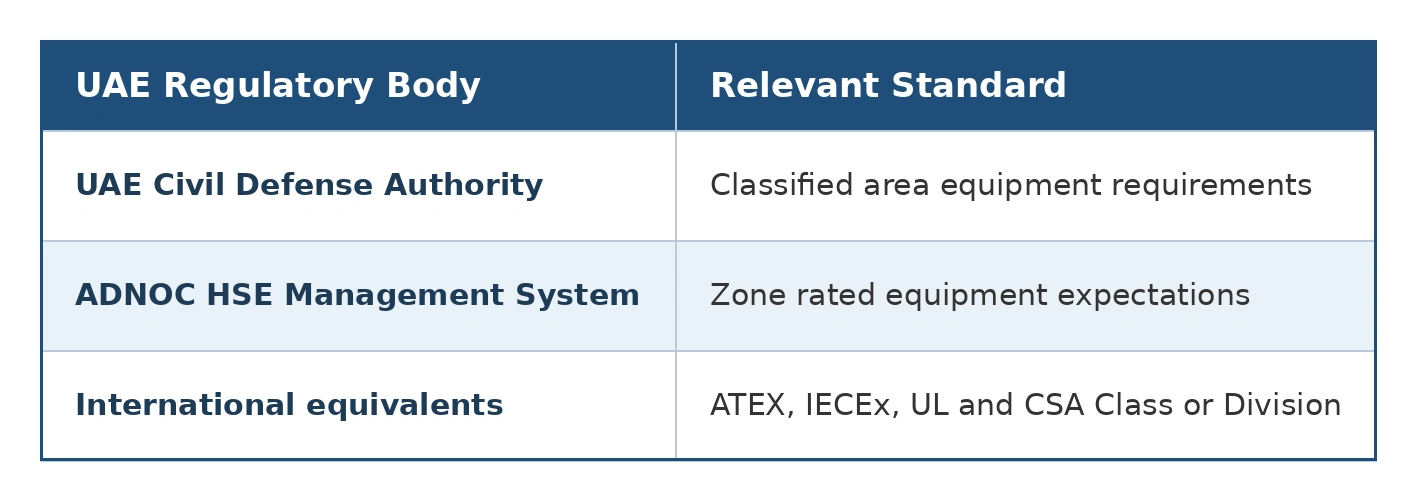
On the regulatory side, three frameworks matter most. The UAE Civil Defense Authority sets requirements for any equipment installed in a classified hazardous area. ADNOC's HSE Management System lays out its own expectations for Zone rated equipment across its operated and partner sites. Internationally, ATEX from the EU and UK, IECEx as the global scheme, and UL or CSA class and division ratings for North American spec projects are the three certification families you will see referenced in tender documents.
 Get this wrong and the consequences are not abstract. Non-compliant equipment can void insurance, increase liability in the event of an incident, and trigger an ADNOC audit failure that halts operations until it is corrected. Any hazardous area camera UAE contractors specify must carry documentation matched to the exact zone of installation, not a generic compliance letter. Before choosing any oil and gas surveillance equipment, it helps to understand what the markings stamped on a camera housing actually mean, because that single label tells you whether a unit belongs in your Zone 1 tank bund or not.
What Explosion Proof Actually Means
This is where a lot of buyers get their terminology tangled, so it is worth separating the three concepts clearly.
An explosion proof rating, the US and NEC term, means the enclosure can contain an internal ignition without rupturing or allowing flame to escape. Flameproof, written as Ex d under IEC and ATEX rules, describes the same underlying concept using international terminology. Intrinsically safe, or Ex i, takes a different approach entirely, limiting the electrical energy in the circuit so that ignition simply cannot occur in the first place. An intrinsically safe camera is often the better fit for smaller instrumentation points where a full Ex d enclosure would be impractical.
You will see these principles expressed through certifications like ATEX II 2G Ex d IIC T6, IECEx certificates, UL Class I Division 1 or 2 listings, IP66, IP67, or IP68 ingress protection, NEMA 4 or 4X enclosure ratings, and a T code running from T1 to T6 that defines the maximum surface temperature the unit can reach.
Zone classification is the piece that ties it all together:
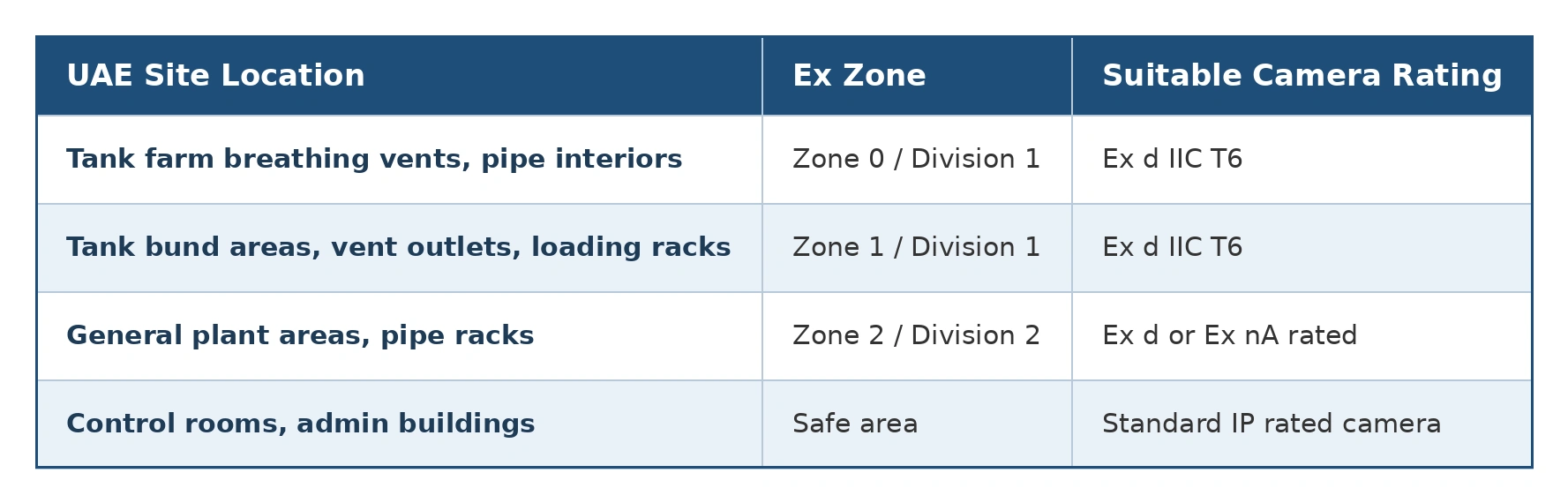 Before signing off on any vendor, ask for the ATEX certificate number, the notified body ID, an IECEx explosion proof camera certificate of conformity listing the exact standard series tested against, the IP rating test report, and written confirmation of the T class. Comparing ATEX camera UAE options side by side gets much easier once you have all five documents in front of you, since a supplier who hesitates on any of them is, in itself, the answer. A basic explosion proof CCTV camera without the correct T-class rating can look identical to a certified one until you check the paperwork.
Key Features to Evaluate
Certification alone does not tell the whole story. A few features separate a camera that survives one UAE summer from one that survives ten.
On the non-negotiable side, look for a valid ATEX or IECEx certificate matched precisely to the Ex zone of the installation point; a minimum IP66 rating for anything outdoor and IP67 or IP68 where washdown or flooding is possible; and housing built from copper-free aluminium or 316L stainless steel, since copper alloys are prohibited in hydrocarbon atmospheres due to spark risk. Any ATEX camera for oil and gas facilities you shortlist should meet every one of these points before price even enters the conversation. The T class must exceed the maximum surface temperature expected on site, the operating range needs to comfortably cover minus 10°C to plus 60°C, and coastal or offshore installations need marine grade coating or passivation to resist corrosion.
Once compliance is settled, performance features decide how useful the camera actually is day to day. Good oil and gas surveillance starts with low light sensitivity, a strong IR illumination range, and WDR or HDR handling for flare, glare, and high contrast scenes, all of which matter enormously in this environment. An explosion proof PTZ camera UAE teams choose for perimeter fencing and flare stack monitoring need to cover far more ground than fixed housing ever could. Combined thermal and visual units add gas leak detection to the mix, and reliable PoE connectivity through Ex rated junction boxes, fiber for long runs, and proper surge protection keep the system stable through summer storms.
Finally, look at what stands behind the hardware. Third party test reports carry more weight than self certification, a modular design lets technicians replace parts without breaking the Ex certification, and a regional presence with UAE and GCC spare parts stock is what keeps a system running when something fails on a Friday night.
Deployment Scenarios and Placement Guidance
High risk zones on any UAE site typically include tank farms, loading and unloading racks, flare stacks, pump stations, compressor houses, LPG or propane storage, and marine loading arms. Matching the right camera type to each of these locations makes a real difference.
An explosion proof PTZ camera suits perimeter coverage, flare stack monitoring, and wide area vessel surveillance where the operator needs to actively scan and zoom. A fixed dome Ex d unit is better suited to tank bund protection, loading rack coverage, and pipe rack corridors where a static, always-on view is what matters. Thermal cameras earn their keep specifically at wellheads and compressor seals, where early gas leak detection can prevent a much larger incident. For offshore platforms and smaller rigs, compact oil rig cams and a small oil rig camera fitted to a confined control cabin often make more practical sense than a full sized fixed dome unit.
On mounting, aim for a minimum height of 3 to 4 meters for anti-vandal protection, angle units carefully to avoid IR bleed from active flares, and plan sight lines to eliminate dead zones before installation day rather than after. Cable routing needs certified Ex junction boxes, barrier cable glands, and conduit rated to match the zone classification, and in coastal or humid areas, heaters, thermostats, and desiccant breathers prevent internal condensation from fogging the lens or corroding electronics inside an enclosed housing.
Integration with Site Safety Systems
A camera that cannot talk to the rest of your safety infrastructure is only doing half its job. Modern deployments integrate through SCADA or DCS via Modbus or OPC UA, feed alarms directly into the plant safety or emergency shutdown system, and stream live to the control room VMS and any remote operations center.
In practice, this looks like edge analytics on the camera catching an early hydrocarbon leak and feeding an alarm straight to SCADA, live video routed to muster stations during an emergency response, flare monitoring footage kept on file for HSE incident review, and a real time feed giving remote operators genuine situational awareness without needing anyone on site. A well integrated oil and gas CCTV camera network should reach the control room without adding extra workload for the operator watching the screens.
Cybersecurity deserves its own mention here rather than an afterthought. Camera networks should sit on a secure Ethernet setup with VLAN segmentation, video streams should carry end to end encryption, NVRs and recorders need hardened configurations with role based access control, and the whole system should integrate with your existing VMS through ONVIF or an open API. For UAE enterprise buyers, alignment with the IEC 62443 industrial cybersecurity framework is increasingly expected rather than optional. A sensible rollout starts with the highest risk Zone 1 areas, expands using edge analytics to control bandwidth, and centralizes everything at the control room or remote operations center as the network matures.
Maintenance, Testing and Lifecycle
Ex rated equipment is not install and forget. IEC 60079-17 sets out the inspection categories worth building a schedule around: visual checks for seal integrity, cable gland tightness, housing corrosion, and lens cleanliness; close inspections covering gasket condition, fastener torque, and conduit seal compound; and detailed internal inspections where a risk assessment calls for them.
Functional testing should confirm video quality, PTZ movement and preset accuracy, IR illumination range, and that recording paths and alarm relays are firing correctly. Any component replacement must use a certified equivalent part, since substituting an uncertified one silently voids the Ex certification. Keep a certificate register, inspection log, and change control record on file, since ADNOC HSE audits and insurance renewals will ask for exactly this documentation, and build a regional stock of seals, gaskets, and IR illuminators with a certified GCC supplier since lead times from Europe can stretch to six or eight weeks.
Why Choose SharpEagle
SharpEagle has been building safety and security solutions since 2009, with a dedicated oil and gas camera portfolio serving operators across the UAE, KSA, Kuwait, and the UK. Our range includes an explosion proof PTZ camera UAE teams rely on for perimeter and flare monitoring, fixed dome Ex-d cameras for tank bund and loading rack protection, combined thermal and visual units for gas leak detection, and compact oil rig cams for tight installation points where space is limited.
A few things set us apart for UAE buyers specifically. Our ATEX certified CCTV UAE portfolio covers Zone 1, and 2 with no grey area equipment, every housing is marine grade corrosion resistant and T6 rated for UAE ambient extremes, and our systems are ONVIF compatible with proven integrations across major SCADA and VMS platforms. Any procurement team sourcing an explosion proof camera for oil and gas industry rollout will find our regional support network offers same day response across the UAE and GCC and local spare parts distribution, plus a genuinely turnkey service covering site surveys, zone classification review, supply, installation, and commissioning.
Following deployment of SharpEagle's Ex rated PTZ and fixed dome cameras across a Gulf region tank farm, the operator reduced false alarm activations by 40 percent and cut emergency response time from 18 minutes down to 6 minutes.
Get the Right Camera for Your Zone
If you are responsible for your site's safety record, the right explosion proof CCTV camera UAE regulators and your own risk assessment will accept is not something to guess at. Request a free UAE site assessment, download the SharpEagle explosion proof camera spec sheet/brochure, or schedule a live product demo, whichever fits where you are in the process. Reach us by phone, email, or the web form on our site, and join the operators across the UAE and GCC who have trusted SharpEagle since 2009.
