

Summary
Why ATEX Zone Classification Can Mean the Difference Between Safety and Disaster
What Is ATEX Zone Classification?
ATEX Zone Classification for Gas and Vapour: Zone 0, Zone 1, Zone 2
- ATEX Zone Classification for Dust: Zone 20, Zone 21, Zone 22
- How to Carry Out ATEX Zone Classification: A Step-by-Step Process
ATEX Equipment Categories, Protection Levels and Temperature Classes
ATEX Zone Classification by Industry: Oil & Gas, Chemical, Logistics and Mining
Introduce SharpEagle Explosion Proof Cameras
ATEX vs IECEx vs NEC: Understanding the Differences
ATEX Compliance Checklist: What Every Safety Manager Must Have in Place
Summary
ATEX zone classification is a legally required process that categorizes hazardous areas by the likelihood and duration of explosive atmospheres. This guide covers gas zones (Zone 0, 1, and 2), dust zones (Zone 20, 21, and 22), the step-by-step zoning process, equipment categories, and how ATEX compares to IECEx and NEC. Essential reading for safety managers in UAE, KSA, and UK industrial environments.
Key Takeaways
- ATEX zone classification divides hazardous areas into gas zones (Zone 0, 1, 2) and dust zones (Zone 20, 21, 22) based on how frequently an explosive atmosphere can form.
- It is a legal obligation under EU Directive 1999/92/EC, UK DSEAR, and IECEx frameworks in UAE and KSA, not a voluntary measure.
- Every piece of equipment installed in a classified zone must carry the correct ATEX or IECEx certification for that zone category.
- The Explosion Protection Document (EPD) is a core compliance deliverable that must be maintained and reviewed regularly.
- ATEX-certified explosion-proof cameras play an increasingly critical role in real-time monitoring across Zone 1 and Zone 2 environments.
Why ATEX Zone Classification Can Mean the Difference Between Safety and Disaster
Industrial explosions in oil, gas, and chemical processing environments account for a significant share of workplace fatalities each year. Many of these incidents share one common factor: an explosive atmosphere was not properly identified before an ignition source made contact.
ATEX stands for ATmosphères EXplosibles. It refers to the European regulatory framework that governs how facilities must assess, classify, and manage areas where flammable gases, vapors, or combustible dust can form explosive mixtures with air.
What is ATEX zone classification in practical terms? It is the formal process of dividing a facility into zones based on how likely and how often an explosive atmosphere might be present. This classification dictates which equipment can operate safely, what protection measures are needed, and how personnel must be trained.
This is not optional. Facilities within the ADNOC supply chain and Aramco-affiliated projects in KSA must align with IECEx, the international equivalent. In the UK, DSEAR carries the same legal weight post-Brexit. This guide covers zones, the classification process, certified equipment, global standards, and a practical compliance checklist.
What Is ATEX Zone Classification?
ATEX zone classification is a risk-based methodology that identifies locations within a facility where explosive atmospheres could form and ranks those locations by severity. That ranking drives decisions on equipment selection, ignition source control, and emergency planning.
An explosion requires three elements: a flammable substance, sufficient oxygen, and an ignition source. Remove any one, and the explosion cannot occur. Zone classification targets the fuel side of that equation.
Two ATEX directives apply in the EU. Directive 1999/92/EC is the workplace directive, requiring employers to carry out hazardous area classification and produce an Explosion Protection Document. Directive 2014/34/EU governs equipment used in explosive atmospheres. One defines the environment; the other defines what can operate within it.
In the UK, DSEAR translates these obligations into domestic law. For UAE and Saudi Arabia, IECEx certification and the IEC 60079 standards serve as the internationally recognized equivalent. Hazardous location classification under IECEx follows the same zone-based approach, which is why equipment certified under one framework is often accepted under the other.
Legal responsibility sits with the employer or facility manager. A competent person, typically a safety engineer or specialist consultant, must conduct the classification.
ATEX Zone Classification for Gas and Vapour: Zone 0, Zone 1, Zone 2
Gas and vapour hazards are classified into three zones based on frequency and duration of exposure.
Zone 0 is the most hazardous. An explosive atmosphere is present continuously or for long periods, typically exceeding 1,000 hours per year. The inside of a storage tank is a classic Zone 0 location. Category 1 equipment is mandatory here.
Zone 1 describes areas where an explosive atmosphere is likely during normal operation, between 10 and 1,000 hours per year. Pump seals, valve flanges, and loading connections commonly fall here. Category 2 equipment is the minimum requirement.
Zone 2 covers areas where an explosive gas atmosphere is not expected during normal operation and, if it does occur, persists only briefly, under 10 hours per year. Open process areas with good ventilation are typical Zone 2 environments.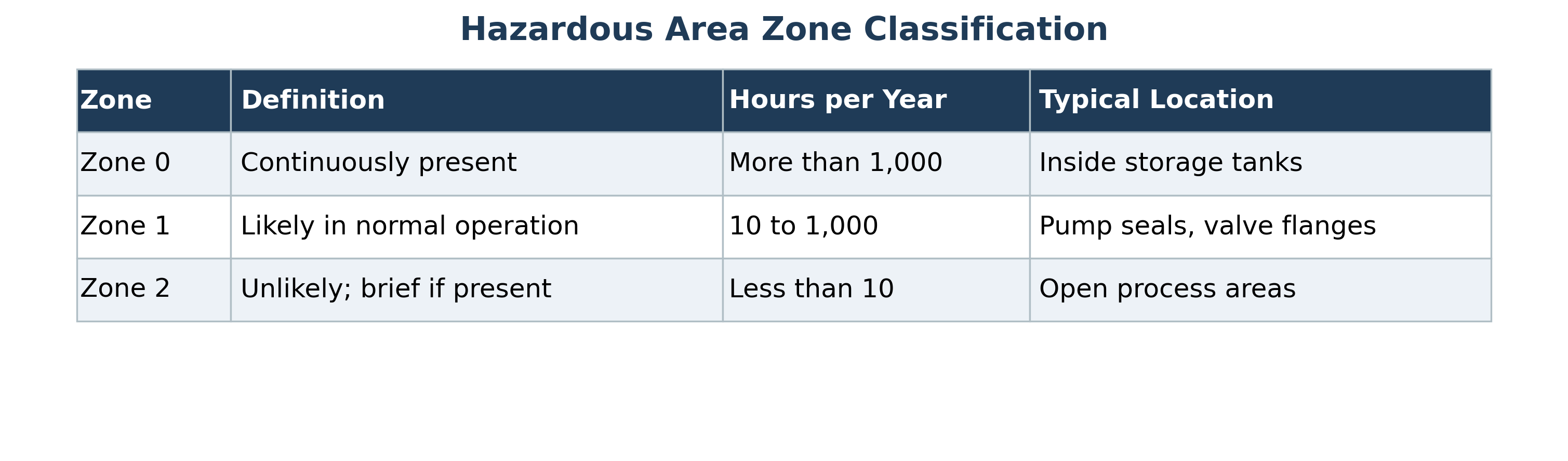 Zones are concentric. Equipment certified for Zone 0 is safe to use in Zone 1 or Zone 2. The reverse does not apply. A petrol station illustrates this well: Zone 0 is inside the underground tank, Zone 1 is at the nozzle and fill point, and Zone 2 is at the perimeter.
ATEX Zone Classification for Dust: Zone 20, Zone 21, Zone 22
Combustible dust is one of the most underestimated explosion hazards in industry. Grain, flour, coal, sugar, and metal powders can all produce catastrophic explosions when suspended in air at the right concentration.
Zone 20 is where a combustible dust cloud is present continuously or for long periods, typically inside silos, hoppers, or dust collectors.
Zone 21 describes areas where dust clouds occur occasionally during normal operation, such as bag filling stations and transfer points.
Zone 22 covers locations where dust clouds are unlikely but may form briefly due to leakage or equipment failure, such as near silo vents or conveyor spillage areas.
Gas-rated equipment cannot be used in dust zones. Equipment must be specifically rated or dual-certified for the relevant dust environment. For UAE and KSA logistics operators in free zones like JAFZA and KIZAD, aerosol storage and flammable goods warehouses frequently trigger Zone 21 and Zone 22 classifications, an area of hazardous area equipment classification that is often overlooked during facility design.
How to Carry Out ATEX Zone Classification: A Step-by-Step Process
Step 1: Collect physico-chemical data on every flammable substance on site, including flash points, ignition temperatures, and explosive limits. Facilities handling H₂S require particular care, as H₂S zone classification must account for hydrogen sulfide being heavier than air and accumulating in low-lying areas.
Step 2: Identify all sources of release, graded as continuous, primary (normal operation), or secondary (abnormal conditions).
Step 3: Assess ventilation. Effective natural or forced ventilation can reduce zone extent, potentially downgrading a Zone 1 to Zone 2.
Step 4: Map the zones and produce classified area drawings. These are working documents used by designers, contractors, and maintenance teams.
Step 5: Identify and control ignition sources, covering electrical equipment, hot surfaces, static electricity, and mechanical sparks.
Step 6: Select appropriate certified EX equipment for each zone. Every item, from lighting to cameras, must carry the correct certification.
Step 7: Produce the Explosion Protection Document. This is a legal requirement under ATEX standards.
Step 8: Schedule regular reviews, especially after plant modifications, process changes, or updates to hazardous location classification drawings.
ATEX Equipment Categories, Protection Levels and Temperature Classes
Category 1 equipment is for Zone 0 and Zone 20. Category 2 covers Zone 1 and Zone 21. Category 3 applies to Zone 2 and Zone 22.
Equipment Protection Levels (EPLs) provide finer classification. EPL Ga, Gb, and Gc apply to gas zones. Da, Db, and Dc apply to dust zones.
Gas subgroups determine which flammable gases a piece of equipment is certified for. Group IIA covers propane. Group IIB covers ethylene. Group IIC, the most demanding, covers hydrogen and acetylene.
Temperature classes run from T1 (450 degrees Celsius maximum surface temperature) to T6 (85 degrees Celsius) and must fall below the ignition temperature of substances present on site.
Reading ATEX marking correctly is a practical skill. Take the marking II 2G Ex db IIB T4 Gb. Group II means surface industries. Category 2G means Zone 1 gas environment. Ex db means flameproof enclosure. IIB means suitable for ethylene-type gases. T4 means a maximum surface temperature of 135 degrees Celsius. Gb confirms Zone 1 suitability. ATEX standards require all this information to appear clearly on every piece of equipment before installation.
ATEX Zone Classification by Industry: Oil & Gas, Chemical, Logistics and Mining
Oil & Gas (UAE and KSA): Offshore platforms, refineries, and wellheads are densely populated with Zone 0 and Zone 1 environments. Hazardous zone classification is embedded into ADNOC and Aramco procurement requirements. NEOM infrastructure projects carry the same expectations.
Chemical (UK and UAE): Solvent handling, paint booths, and pharmaceutical recovery operations generate Zone 1 and Zone 2 gas environments. UK facilities must address COMAH and DSEAR obligations in parallel, while UAE chemical plants follow IECEx-aligned frameworks under MOEI requirements.
Logistics and Warehousing (UAE and KSA): Aerosol storage, battery charging, and flammable liquid warehouses in free zones frequently require Zone 2 and Zone 21 classifications. Tenant activity changes can quickly render zone maps outdated, making periodic hazardous area classification reviews essential.
Mining (UK and KSA): Underground methane, coal dust, and mineral processing create Zone 1 and Zone 20 to Zone 21 environments. Group I equipment categories M1 and M2 apply underground. KSA mining expansion under Vision 2030 is driving increased demand for IECEx-compliant monitoring systems.
Introduce SharpEagle Explosion Proof Cameras
SharpEagle's explosion-proof cameras are ATEX and IECEx certified for Zone 1, Zone 2, Zone 21, and Zone 22 environments. Built for oil & gas, chemical, mining, and logistics facilities across UAE, KSA, and the UK, they deliver continuous real-time monitoring in the most hazardous areas. These are purpose-built ex equipment solutions, not adapted commercial cameras. When your team needs live situational awareness without entering a classified zone, SharpEagle provides a safe and fully compliant answer. The range also satisfies hazardous area equipment classification requirements across all key global markets.
ATEX vs IECEx vs NEC: Understanding the Differences
ATEX is mandatory in the EU. Post-Brexit, the UK has moved to UKCA marking, though technical standards remain closely aligned. Equipment holding ATEX certification is generally accepted in UK facilities during the transition period.
IECEx is the international standard, accepted in over 30 countries, including UAE, KSA, Australia, and India. For projects spanning multiple markets, IECEx offers the broadest acceptance. ATEX standards and IECEx are technically aligned, and dual certification is common.
NEC (National Electrical Code) is the US framework. It uses a class and division system. Class I Division 1 broadly maps to Zone 1. Class I Division 2 maps to Zone 2. US-origin equipment deployed in ATEX or IEC Ex-territories require careful review as certifications are not directly interchangeable. For procurement teams managing ADNOC, Aramco, or SABIC supply chains while supplying into EU or UK markets, specifying IECEx-certified equipment from the outset avoids significant rework.
ATEX Compliance Checklist: What Every Safety Manager Must Have in Place
- Hazardous area classification study completed by a competent person
- Classified zone drawings produced, current, and accessible on site
- Explosion Protection Document in place and regularly updated
- All installed equipment verified as ATEX or IECEx certified for the correct zone
- Ignition source controls documented and physically implemented
- Staff trained to CompEx or IECEx CoPC standard
- Maintenance procedures specific to Ex equipment established
- Periodic zone classification review scheduled, especially after plant changes
- ATEX-certified surveillance systems, including explosion-proof cameras, installed across Zone 1 and Zone 2 areas
Contact SharpEagle today for a no-obligation technical consultation.
