

Summary
Introduction
Why Forklift Safety Solutions Are Essential
Types of Forklift Safety Solutions & Use Cases
- A. AI Forklift CCTV Solutions
- B. Forklift Radar System — Blind Spot Detection
- C. Forklift Wireless Camera System
- D. Radar Object Detection System (RODS-L)
- E. 360 Degree Bird-Eye View Camera System
- F. Forklift Explosion Proof Camera System
- G. Safe Zone Corner Guard
- H. Forklift Wired Camera System
- I. Forkview Camera System
How to Choose the Right Forklift Safety Solutions
- A. Assess Your Operating Environment
- B. Identify Key Risk Areas
- C. Compliance & Standards
- D. Integration & Scalability
Installation & Maintenance Best Practices
Common Forklift Safety Mistakes to Avoid
Forklift Safety Regulations & Compliance Overview
Conclusion
Summary
This complete forklift safety solutions guide explores essential systems like forklift camera system tech, radar detection, AI forklift CCTV solutions, and warehouse forklift safety best practices. It explains why advanced safety systems matter, outlines OSHA forklift safety and regional forklift regulations (UK, UAE, KSA), and shows how to choose, install, and maintain systems that prevent accidents. The guide helps you build safer, more efficient operations with real-world examples, comparison charts, mounting visuals, and an actionable forklift safety checklist infographic.
Introduction
Forklifts are the unsung workhorses of modern warehouses, logistics centers, and industrial sites. These powerful machines lift, move, and stack heavy loads with incredible efficiency. But that efficiency comes with risk. Without the right forklift safety solutions, blind spots, high pedestrian interaction, and poor visibility can lead to serious accidents, property damage, and costly downtime.
Across busy warehouse floors, risks multiply when humans and machines share space. That’s why organizations are shifting from basic warehouse forklift safety policies to layered, technology-driven systems that prevent incidents before they happen.
In this complete guide, you’ll learn:
- Why forklift safety systems are essential
- The types of technology available, from radar to AI cameras
- How to align with OSHA forklift safety and regional forklift regulations
- Best practices for installation, maintenance, and training
- Real-world use cases to help you choose the right solutions
Let’s get started with why these systems are so critical.
Why Forklift Safety Solutions Are Essential
A. Accident Prevention
Forklift accidents remain a major hazard in industrial settings. According to the U.S. Bureau of Labor Statistics, forklifts contribute to more than 85,000 serious injuries annually, with many tied to visibility issues and collisions between forklifts and pedestrians (source: OSHA).
Key accident scenarios include:
- Forklift collisions with workers in aisles
- Striking shelving due to blind spots
- Load tip-overs on uneven surfaces
- Forklift vs. infrastructure impacts
Most of these accidents trace back to poor line of sight and delayed detection. That’s where forklift camera systems, forklift blind spot detection and radar object detection systems play a vital role. By enhancing situational awareness and alerting operators to obstacles, these technologies significantly reduce risk.
B. Compliance with Safety Regulations
In many regions, organizations must meet formal safety standards:
- OSHA forklift safety expectations in the United States outline rigorous training, inspection, and risk control requirements.
- In the UK, HSE & PUWER forklift regulations govern machinery safety and operator duties.
- UAE and KSA local standards align with international best practice, requiring documented safety plans and periodic audits.
Non-compliance can lead to fines, work stoppages, insurance disputes, and reputational damage.
C. Improved Operational Efficiency
Investing in forklift safety doesn’t just protect workers — it enhances workflow.
Benefits include:
- Fewer interruptions due to collisions
- Reduced damage to goods and racking
- Better operator confidence
- Smoother logistics throughput
In fast-paced environments, even small improvements in visibility and detection can save tens of thousands of dollars.
Types of Forklift Safety Solutions & Use Cases
Here’s a breakdown of the most effective forklift safety solutions on the market — from basic camera upgrades to advanced AI-powered systems.
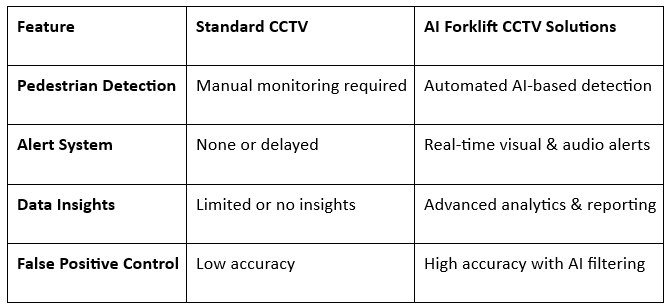
A. AI Forklift CCTV Solutions
What It Is:
AI-enhanced forklift CCTV systems combine cameras with artificial intelligence to detect hazards in real-time.
How It Helps:
- Intelligent alerts for pedestrians and obstacles
- Automatic recording of safety events
- Operator assistance when visibility is limited
Best For:
High-traffic warehouses, logistics hubs with mixed pedestrian/vehicle traffic.
Interactive Visual Example (Comparison Chart):
B. Forklift Radar System — Blind Spot Detection
What It Is:
Radar-based systems mounted on forklifts detect moving and stationary objects that cameras may miss, especially in dusty or low-light environments.
How It Helps:
- Detects objects beyond visual range
- Alerts operators with sound/vibration
- Works in challenging conditions
Best For:
Environments where visibility is routinely compromised.
C. Forklift Wireless Camera System
What It Is:
Wireless camera systems without cables, offering flexibility and fast installation.
How It Helps:
- No complex wiring
- Easy retrofitting
- Portable between machines
Best For:
Existing fleets needing quick upgrades to warehouse forklift safety without downtime.
D. Radar Object Detection System (RODS-L)
What It Is:
Advanced radar systems that scan wider zones and differentiate between object types.
How It Helps:
- Pedestrian and obstacle alerts
- Detection in cluttered or open yards
- Works even with environmental interference
Best For:
Loading bays and outdoor staging areas.
E. 360 Degree Bird-Eye View Camera System
What It Is:
A 360 Degree Bird Eye View camera system is multi-camera system that streams a real-time surround view to operators.
How It Helps:
- Eliminates blind spots entirely
- Seamless view of all sides
- Reduces collisions in tight spaces
Best For:
Complex warehouse layouts and narrow aisles.
(Short Explainer Video Suggestion: “360° Forklift Camera System in Action” — embed before this section.)
F. Forklift Explosion Proof Camera System
What It Is:
Specialised ATEX-certified Forklift cameras designed for hazardous environments.
How It Helps:
- Safe in volatile atmospheres
- Meets ATEX forklift camera standards
- Continues surveillance in high-risk zones
Best For:
Oil & gas, chemicals, and hazardous warehouses.
G. Safe Zone Corner Guard
What It Is:
Safe Zone Corner Guard is physical guards and visual indicators installed at corners or intersections.
How It Helps:
- Reduces impact force
- Makes blind corners safer
- Complements digital systems
Best For:
Dense aisle intersections and high-impact zones.
H. Forklift Wired Camera System
What It Is:
Hardwired camera systems with high stability and delay-free video.
How It Helps:
- Stable, real-time feed
- No interference
- Longer operational life
Best For:
Heavy-duty operations with long shifts.
I. Forkview Camera System
What It Is:
Forkview Camera System is specialised forward and rear camera tech that improves load and pathway visibility.
How It Helps:
- Better load handling
- Precise maneuvering
- Instant feedback to operator
Best For:
Stacking operations and tight load zones.
How to Choose the Right Forklift Safety Solutions
Selecting the right forklift safety solutions requires more than choosing the latest technology. It involves understanding your operating conditions, identifying risks, meeting compliance requirements, and ensuring systems can scale with your operations. A structured evaluation helps ensure safety investments deliver long-term value.
A. Assess Your Operating Environment
Start by mapping your warehouse:
- Indoor or outdoor operations?
- Lighting quality?
- Pedestrian density?
- Traffic flow?
AI forklift CCTV solutions excel in crowded spaces. Radar systems shine where visibility is compromised.
B. Identify Key Risk Areas
Key risk zones often include:
- Blind spots
- Intersections
- Aisles narrower than 2 meters
- Loading and unloading docks
Conduct a baseline forklift safety assessment to prioritise solutions.
C. Compliance & Standards
Ensure your chosen systems align with:
- OSHA forklift safety guidelines
- ANSI / ITSDF standards
- Regional rules in UK (HSE & PUWER), UAE, KSA
Write documented SOPs that incorporate these solutions.
D. Integration & Scalability
Consider:
- Retrofitting vs new installation
- Compatibility with different forklift models
- Future expandability (e.g., adding AI modules later)
A modular setup helps you scale without replacement.
Installation & Maintenance Best Practices
Proper installation and consistent maintenance are essential to ensure forklift safety systems perform reliably. Even advanced technology can fail if installed incorrectly or left unchecked.
A. Installation Guidelines
Correct mounting positions are key to effective forklift safety systems.
Visual Example (Mounting Infographic):
- Front camera: just above fork carriage
- Rear camera: central high point
- Radar units: front and sides, ~1 meter height
- Cables routed away from pinch points
- Power supply secured and protected
This infographic should show placement angles and distance guidelines.
B. Preventive Maintenance
Routine checks keep systems reliable:
- Clean lenses and radar sensors
- Check for loose wiring
- Update firmware regularly
- Monitor alert logs for patterns
C. Training & Awareness
Technology is only as good as the people who use it. Train:
- Operators on alert meaning and response
- Pedestrians on safe zones and signals
- Supervisors on system diagnostics
Common Forklift Safety Mistakes to Avoid
Even with advanced forklift safety systems in place, common mistakes can undermine safety efforts. Recognising and avoiding these pitfalls helps maintain consistent protection across operations.
Avoid these pitfalls:
- Relying solely on operator experience
- Installing without a risk assessment
- Poor calibration of sensors and cameras
- Ignoring layout changes over time
Even the most advanced forklift safety systems fail when forgotten.
Forklift Safety Regulations & Compliance Overview
Compliance with forklift safety regulations is a foundational requirement for safe operations. Regulations define minimum expectations for training, equipment condition, and risk management.
OSHA Forklift Safety Requirements
- Operator training
- Periodic evaluation
- Documentation of risk controls
ANSI / ITSDF Standards
International standards that guide truck performance and inspection.
Region-Specific Regulations
UK: Health & Safety Executive (HSE) and PUWER guidelines
UAE: Industrial safety aligned with OSHA-like expectations
KSA: Standards from SASO and local authorities
Compliance isn’t optional — it’s good business.
Conclusion
Safety is a layered effort. Combining forklift safety systems like AI CCTV, radar detection, and robust camera setups creates redundancy that drastically cuts accident risk. Operators work more confidently, regulations are met, and your facility runs smoother.
Take action now:
- Explore our forklift safety solutions
- Request a free forklift safety assessment
- Start building a safer, smarter warehouse
SharpEagle Technology delivers comprehensive Forklift Safety Solutions across the UAE, Saudi Arabia, Oman, Kuwait, Bahrain, and Qatar. Our solutions are designed to enhance operator visibility, prevent accidents, and improve workplace safety in industrial environments. With continuous global expansion, we are bringing intelligent forklift safety technologies to businesses around the world.
