

Summary
KEY TAKEAWAYS
Introduction
Why Standard Cameras Fail on Offshore Rigs
Explosion Proof PTZ Camera — Key Technical Features
- ATEX/IECEx Certification
- PTZ Mechanics for Hazardous Zones
- Imaging Technologies
- Network and Integration
- Feature Comparison: Standard PTZ vs. Explosion Proof PTZ
Critical Deployment Zones on Offshore Oil Rigs
- Wellhead and Derrick Areas
- Flare Stack and Process Module Perimeters
- Helideck and Personnel Access Points
- Subsea Module and Moonpool Areas
- Control Room and Muster Station Approaches
Compliance and Regulatory Standards
Why SharpEagle? Introducing Our Explosion Proof PTZ Camera Range
Buyer's Checklist — How to Choose the Right Explosion Proof PTZ Camera for Oil Rigs
Conclusion
Summary
Offshore oil rigs operate in some of the world's most explosive and corrosive environments, where standard surveillance cameras simply cannot survive. This guide covers why explosion proof PTZ cameras are essential for Zone 1 and Zone 2 hazardous areas, what technical features matter most, how to meet ATEX and IECEx compliance requirements, and how SharpEagle's certified range protects facilities across the UAE, KSA, and beyond.
KEY TAKEAWAYS
- Zone 1 and Zone 2 oil rig locations require ATEX Category 2G or 3G certified PTZ cameras - using uncertified equipment creates both ignition risk and serious regulatory liability.
- A standard PTZ camera becomes an ignition source in explosive gas atmospheres. Only an explosion proof enclosure eliminates that risk.
- Thermal imaging, 40x optical zoom, and AI auto-tracking are now standard expectations in certified offshore PTZ systems.
- SharpEagle has supplied ATEX and IECEx-certified explosion proof PTZ cameras to oil and gas operators across UAE, KSA, Kuwait, and Oman.
Introduction
Offshore oil rigs are unforgiving environments. Flammable gas atmospheres, corrosive sea air, relentless vibration, and round-the-clock operational pressure leave zero margin for error in surveillance infrastructure.
For facility managers across the UAE, KSA, and GCC, deploying uncertified cameras in classified hazardous zones is both a safety risk and a serious regulatory liability. The explosion proof PTZ camera for oil rigs exists to close that gap. These are purpose-engineered systems designed for classified hazardous zones where a standard PTZ security camera would either fail mechanically or become an ignition source.
SharpEagle has been supplying certified industrial safety and security solutions, with active projects across the UAE, KSA, Kuwait, Oman and more, serving oil and gas operators who cannot afford surveillance gaps.
An explosion proof PTZ camera for oil rigs is a pan-tilt-zoom surveillance camera built to ATEX and IECEx certification standards, specifically engineered to operate without igniting explosive gas or vapor atmospheres in Zone 1 and Zone 2 hazardous areas. Unlike a standard PTZ security camera, it uses a flameproof or increased-safety enclosure, rated to IP66 or IP68, to contain any heat or electrical event within the housing.
Why Standard Cameras Fail on Offshore Rigs
A standard PTZ security camera generates operational heat and produces sparks during power cycling. In Zone 1 or Zone 2 areas on an oil rig, where flammable gas is present during or between normal operations, either of these events can trigger ignition. Offshore salt air also corrodes unprotected electronics within months, and drilling vibration causes premature mechanical failure in non-industrial enclosures.
The Explosive Atmosphere Challenge
ATEX zone classifications define the practical risk level at every point on a rig. Zone 1 covers areas where explosive gas or vapor is likely during normal operation. Zone 2 applies where it may occur occasionally. A standard PTZ security camera generates operational heat and can produce electrical sparks during power cycling or component failure, both of which are ignition risks in these environments. Salt-laden offshore air corrodes unprotected electronics far faster than any land-based site, and constant drilling vibration causes premature mechanical failure. No commercial camera survives these combined conditions long-term.
Regulatory and Compliance Implications
ATEX Directive 2014/34/EU and IECEx certification are legal requirements for hazardous-area equipment across EU, UK, UAE, and KSA markets. Major operators including ADNOC and Saudi Aramco both mandate IECEx Certificates of Conformity from equipment suppliers. UAE OSHA and SASO regulations in KSA carry parallel requirements. Using a non-certified explosion proof camera for oil and gas industry applications creates significant liability exposure for facility managers and operating companies if an incident occurs. Compliance is not optional; it is foundational.
Operational Blind Spots
Fixed-angle standard cameras cannot cover derrick tops, flare stack perimeters, or wellhead zones effectively. Without proper low-light camera capability or infrared imaging, night shift monitoring is unreliable. When an incident develops, a fixed camera cannot follow it. Spills, fire propagation, and unauthorized access all require a camera that can pan, tilt, and zoom dynamically to track what is actually happening in real time.
Explosion Proof PTZ Camera — Key Technical Features
ATEX/IECEx Certification
An ATEX PTZ camera carries one of three primary protection concepts. Ex d (flameproof) contains any ignition within the enclosure, so it cannot reach the surrounding atmosphere. Ex e (increased safety) eliminates ignition sources through design. Ex ia/ib (intrinsic safety) limits electrical energy to levels incapable of igniting the atmosphere under any fault condition. Certification matters not just legally but operationally, because the right protection concept depends on the exact zone classification and hazard profile of each deployment location.
PTZ Mechanics for Hazardous Zones
A 360 degree PTZ camera eliminates blind spots across the full rig perimeter from a single mounting point, which on large offshore structures represents a significant cost and coverage advantage. A high zoom PTZ camera with 30x to 40x optical capability lets control room operators identify personnel, read equipment labels, or detect early leak signatures at a distance without anyone entering a hazardous area. Auto tracking PTZ camera functionality uses on-board AI motion detection to follow subjects automatically, removing dependence on manual operator input during fast-moving critical incidents.
Imaging Technologies
A thermal PTZ camera detects heat signatures invisible to standard optics, identifying gas flare irregularities and early-stage fire events before they escalate into emergencies. An IR PTZ camera provides infrared night vision for reliable surveillance in total darkness, which is essential for nightshift operations across remote rig areas. Low light camera performance has advanced considerably, with Sony STARVIS and advanced CMOS sensors now delivering usable imagery at very low lux levels, covering the difficult in-between conditions of dusk, dawn, and partial lighting.
Network and Integration
An IP PTZ camera supporting H.265/H.264 compression and full ONVIF compliance integrates cleanly with any major VMS platform without proprietary dependencies. Long range PTZ camera deployment across large offshore structures often requires fiber or PoE+ transmission over distances exceeding 100 meters, and cameras must be specified to handle this. Cybersecurity-hardened firmware is equally critical as OT and IT networks increasingly converge on modern offshore platforms, creating new attack surfaces that need to be managed.
Feature Comparison: Standard PTZ vs. Explosion Proof PTZ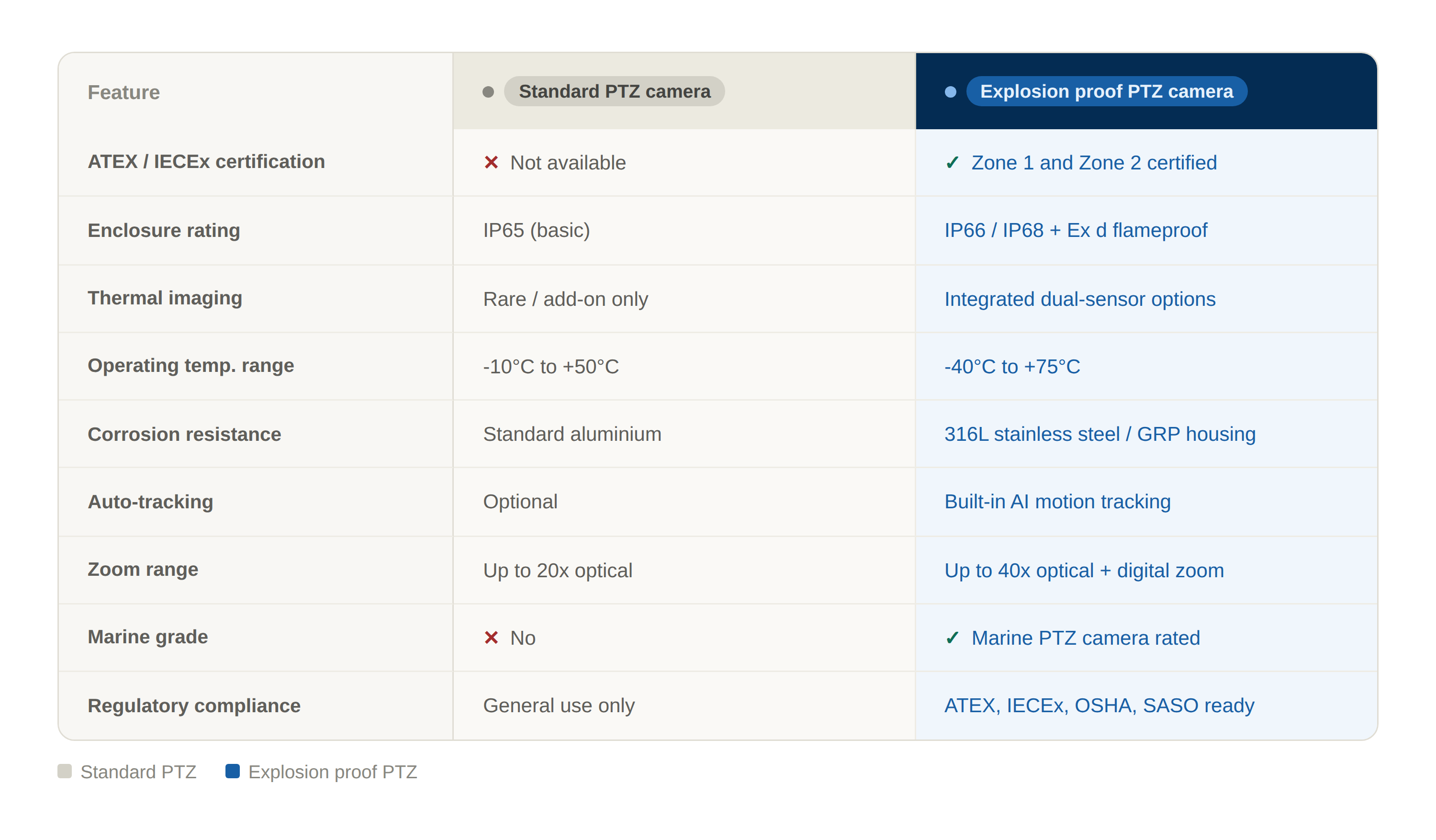
Critical Deployment Zones on Offshore Oil Rigs
Wellhead and Derrick Areas
The wellhead and derrick structure carry the highest explosion risk on any rig. Continuous coverage using a long range PTZ camera with ATEX Zone 1 certification is essential here. A single well-positioned unit with sufficient zoom can cover the full derrick height, reducing total camera count while maintaining complete visibility. Dual-sensor thermal and optical models are the recommended specification for these locations.
Flare Stack and Process Module Perimeters
Flare stacks operate at elevated temperatures by design, making it genuinely challenging to distinguish a heat emergency from routine flare activity using standard equipment. A thermal PTZ camera calibrated for industrial operating conditions handles this by allowing operators to set meaningful thermal thresholds relevant to actual site conditions. An industrial PTZ camera with SUS316L stainless steel housing is the right specification here given the combination of extreme heat and corrosive process gases.
Helideck and Personnel Access Points
Helideck installations face extreme wind exposure, constant salt spray, and the need to monitor personnel movement accurately around the clock. An IR PTZ camera addresses the nighttime visibility requirement, while auto tracking supports mustering compliance and access control monitoring. Marine PTZ camera specifications are appropriate for helideck installations, with IP68-rated housings and fully corrosion-resistant materials as the baseline requirement.
Subsea Module and Moonpool Areas
Moonpool and subsea module zones are subject to water ingress that would destroy inadequately rated equipment quickly. IP68-rated explosion proof surveillance cameras are the correct specification for these areas. A high zoom PTZ camera also allows control room operators to remotely inspect subsea equipment connections and assess conditions without requiring personnel to physically access zones that are both hazardous and difficult to reach safely.
Control Room and Muster Station Approaches
Emergency scenarios frequently unfold in disrupted or low lighting conditions. Low light PTZ cameras at control room approaches and muster station access points ensure imagery remains clear and actionable regardless of ambient lighting. ONVIF-compliant IP PTZ camera architecture at these points supports direct integration with SCADA and emergency response systems, enabling a coordinated response when it matters most.
Compliance and Regulatory Standards
ATEX Directive (EU/UK)
ATEX Directive 2014/34/EU sets the legal framework for equipment used in explosive atmospheres across EU member states. Post-Brexit, Great Britain requires UKEX marking for the GB market. SharpEagle supplies units carrying both ATEX and UKEX certification where required. Category 2G equipment is required for Zone 1 installations and Category 3G for Zone 2. Confirming which category applies to each camera location on your rig is a fundamental step before procurement begins.
IECEx (International — UAE and KSA)
IECEx is the internationally recognized standard expected by major operators across the Gulf. ADNOC facilities in Abu Dhabi and Saudi Aramco installations in KSA both require IECEx Certificates of Conformity. SASO alignment covers Saudi-specific project requirements, while UAE facilities must also consider FANR and ESMA regulatory frameworks for offshore and onshore energy operations.
Marine and Offshore Specific Standards
Beyond ATEX and IECEx, offshore installations carry additional certification requirements. SOLAS compliance applies to offshore platform safety systems. DNV GL and Lloyd's Register type approvals are relevant for FPSO and FSO vessel installations. API RP 505 guidelines on fixed detection systems in petroleum facilities provide the framework for integrating camera systems into broader fixed detection and safety response architecture.
Why SharpEagle? Introducing Our Explosion Proof PTZ Camera Range
SharpEagle Technology has been engineering certified safety and security solutions for high-risk industrial environments since 2009. With over 15 years of proven presence across the UAE, KSA, Kuwait, and GCC, SharpEagle supplies ATEX and IECEx-certified explosion proof PTZ cameras to oil and gas operators, EPC contractors, and facility safety teams who need equipment that performs under real industrial conditions.
Product Range Highlights
SharpEagle's range covers every offshore surveillance requirement:
- ATEX-Certified Explosion Proof PTZ Cameras: Zone 1 and Zone 2 rated with full pan-tilt-zoom and 360 degree continuous coverage
- Thermal and Optical Dual-Sensor PTZ: Early fire and gas leak detection for flare stack and wellhead deployment
- Long Range IR PTZ Cameras: Infrared range up to 500 metres for perimeter monitoring across large offshore structures
- Auto-Tracking Explosion Proof PTZ: AI-powered motion tracking without continuous operator input
- Marine Grade PTZ Systems: IP68-rated with SUS316L stainless steel housing for sea-going and coastal installations
What Sets SharpEagle Apart
Full certification support means clients receive complete ATEX, IECEx, and UKEX documentation as part of every supply package. Regional expertise translates into dedicated teams in UAE and KSA with first-hand understanding of ADNOC and Saudi Aramco supply chain requirements. End-to-end service covers site survey, system design, supply, installation, commissioning, and ongoing maintenance under one accountable partner. Every camera in the range is ONVIF compliant, ensuring clean integration with Milestone, Genetec, and Avigilon VMS platforms.
Request a Free Site Assessment from SharpEagle. Our hazardous area specialists will evaluate your rig layout and recommend the right certified PTZ solution for your zone classifications and operational requirements.
Buyer's Checklist — How to Choose the Right Explosion Proof PTZ Camera for Oil Rigs
- Confirm hazardous zone classification (Zone 0, Zone 1, or Zone 2) for each deployment location before specifying any equipment
- Verify ATEX category (2G for Zone 1, 3G for Zone 2) and confirm IECEx Certificate of Conformity documentation is available from the supplier
- Define imaging requirements: high zoom PTZ camera for long-range identification vs thermal PTZ camera for heat and flare detection
- Assess low light camera minimum illumination specifications to confirm 24/7 operational capability
- Evaluate auto tracking PTZ camera capability: on-board AI tracking vs VMS-dependent tracking
- Check enclosure rating: IP66 minimum for general offshore use and IP68 required for moonpool and splash zones
- Confirm IP PTZ camera network compatibility: ONVIF compliance, PoE+ support, and VMS integration
- Request a maintenance and calibration SLA specific to offshore deployment from your supplier
- Evaluate housing material: 316L stainless steel or GRP construction for marine PTZ camera applications in salt-exposed environments
- Validate operating temperature range against your rig's actual environmental profile, particularly near process modules and flare stacks
Conclusion
Offshore oil rigs across the Gulf region and beyond demand surveillance built specifically for explosive atmospheres. An explosion proof PTZ camera combining ATEX and IECEx certification, thermal imaging, auto tracking, and long range optical performance delivers the most comprehensive monitoring solution available for hazardous Zone 1 and Zone 2 environments.
For safety managers and facility managers responsible for these installations, compliance is non-negotiable. SharpEagle brings over 15 years of industrial expertise and a fully certified product range to every project, from initial site survey through to long-term maintenance. We currently serve clients across the UAE, Saudi Arabia, Oman, Kuwait, Bahrain, and Qatar, with continued global expansion underway.
Contact SharpEagle today for a no-obligation site assessment tailored to your facility's specific requirements.
