

Summary
Key Takeaway
Introduction
What Does ATEX Mean?
What is an ATEX Rated Camera?
How Does a Camera Actually Get ATEX Certified?
Decoding the ATEX Label: A Full Breakdown
ATEX Zones: Gas vs Dust, and Why It's Not Just Pick the Highest Number
ATEX vs IECEx vs North American Standards (UL/CSA/NEC)
Types of ATEX Rated Cameras and What They're Actually Good For
How to Choose the Right ATEX Camera: A Buyer's Framework
Common Mistakes When Buying or Using ATEX Cameras
Top ATEX-Rated Cameras Compared
Maintenance, Inspection, and Compliance Upkeep
SharpEagle ATEX Explosion-Proof Digital Camera
Where Are Explosion-Proof Cameras Required in the UAE?
How to Choose the Right ATEX Camera — Buyer Checklist
Conclusion
Summary
An ATEX rated camera is independently tested to operate safely where flammable gases, vapors, or dust are present. This guide covers what is ATEX certification, ATEX certification UAE rules, and the difference between ATEX and IECEx. It explains how a camera earns certification, how to decode an ATEX label, and how gas and dust zones differ. Buyers will also find a framework for choosing the right ATEX certified camera, common mistakes to avoid, and SharpEagle's explosion proof camera range for UAE sites.
Key Takeaway
- An ATEX rated camera is independently tested to prevent ignition (not survive an explosion) in zones with flammable gases, vapors, or dust, using flameproof or intrinsically safe construction.
- The UAE primarily relies on IECEx, not ATEX, though many GCC operators still specify both certifications to meet international project standards.
- Zone classification (gas: 0/1/2, dust: 20/21/22) must match the facility's actual Hazardous Area Classification — picking a higher zone rating "to be safe" is a common and costly mistake.
- Buyers need to verify four things together: zone rating, gas group (IIA/IIB/IIC), temperature class (T1–T6), and IP rating — matching only one or two isn't sufficient.
- Certification can be voided by unauthorized repairs, damaged seals, non-OEM parts, or opening/charging the unit inside a hazardous area, so maintenance discipline matters as much as the initial purchase.
- UAE bodies like ADNOC, DEWA, and the Fire and Life Safety Code mandate certified equipment in classified zones, spanning oil & gas, petrochemical, offshore, pharmaceutical, and mining sectors.
- SharpEagle Ex-Proof Digital Camera offers ATEX/IECEx dual certification, Zone 1/2 gas and Zone 21/22 dust coverage, IIA/IIB/IIC gas compatibility, and marine-grade stainless steel housing with optional PTZ.
Introduction
An ATEX rated camera is built to operate safely where explosive gases, vapours, or dust may be present. Across the UAE's oil and gas, petrochemical, offshore, and energy sectors, this certification is a legal requirement. ATEX standards began in Europe but remain a global safety benchmark. SharpEagle Technology supplies ATEX and IECEx certified explosion proof cameras across the UAE and GCC. This guide covers what ATEX means, how certification works, ATEX versus IECEx, and choosing the right camera.
What Does ATEX Mean?
ATEX stands for Atmospheres Explosibles, shorthand worldwide for hazardous area equipment standards. ATEX 137 covers worker safety; ATEX 95 covers equipment standards. The UAE primarily follows IECEx, which closely mirrors ATEX, though many operators still specify ATEX compliant equipment for international project standards across Abu Dhabi facilities, Dubai industrial zones, offshore platforms, and petrochemical refining.
Certification Standards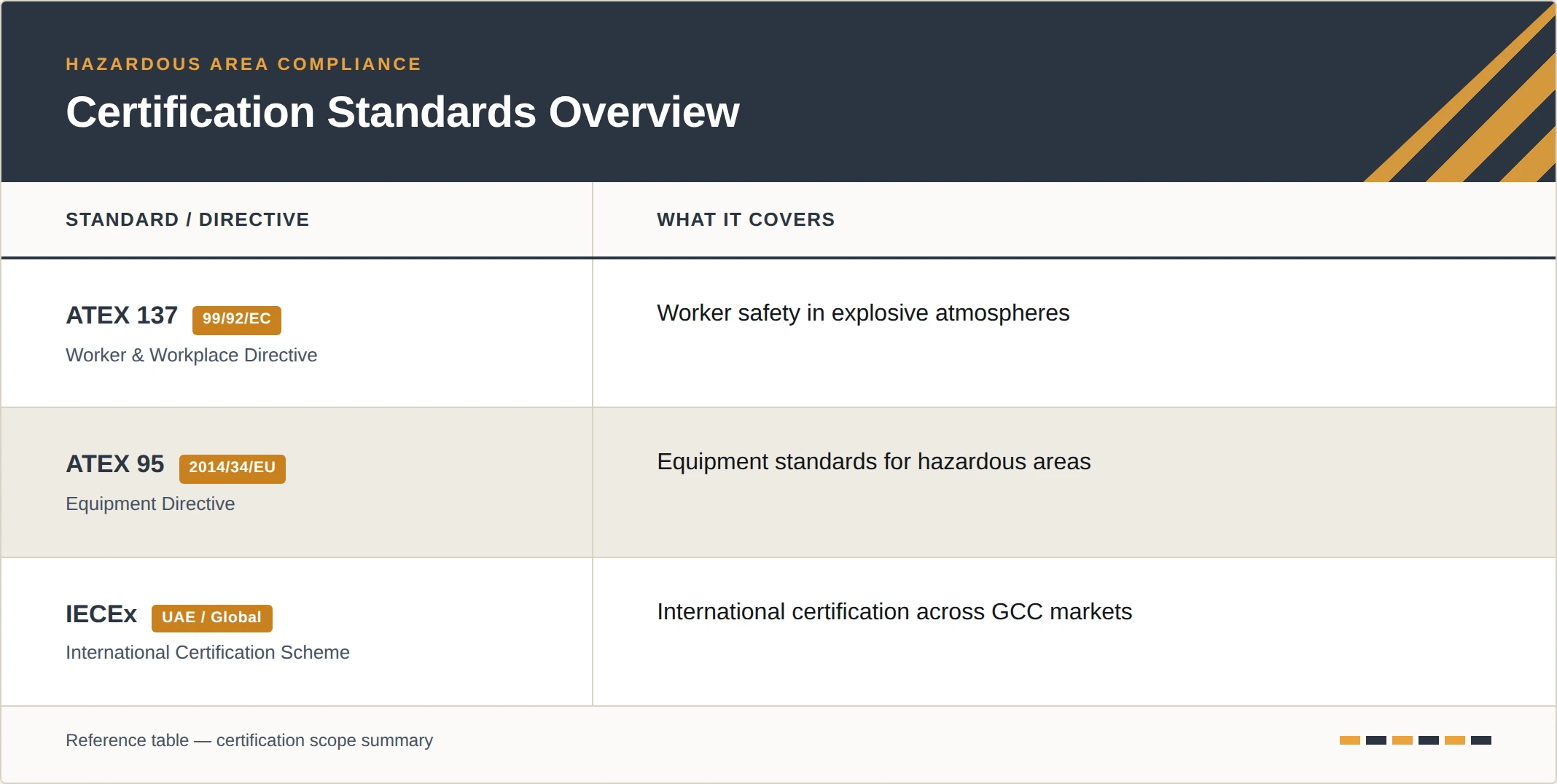
What is an ATEX Rated Camera?
An ATEX digital camera is engineered and independently tested for hazardous environments containing flammable gases, vapours, dust, or chemical mist. An ATEX certified camera uses spark proof construction, flameproof enclosure design, and controlled surface temperatures. Common enclosures use marine-grade stainless steel, aluminum alloy, or GRP. Importantly, these cameras aren't built to survive an explosion; they prevent the ignition that causes one.
What Sets ATEX Cameras Apart from Standard Camera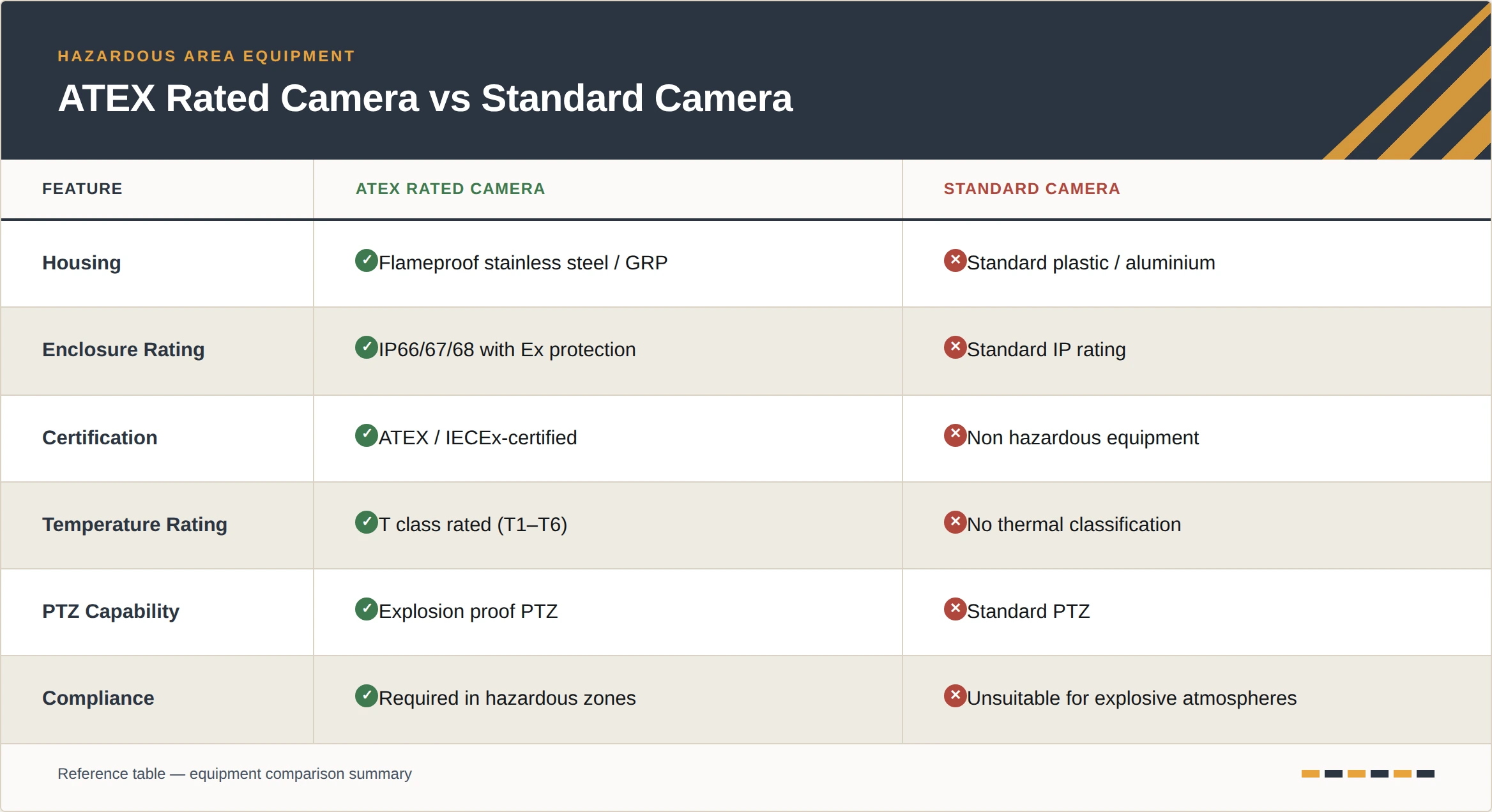
How Does a Camera Actually Get ATEX Certified?
Notified Bodies test ignition sources, surface temperature, enclosure integrity, and spark risk. Category 3 equipment can be self-certified; categories 1 and 2 need third-party testing, adding time and cost.
Read more: Complete Guide to Explosion Proof Digital Cameras
Decoding the ATEX Label: A Full Breakdown
ATEX certification explained simply: the label encodes protection type, equipment group, category, gas group, and temperature class. "Ex ib/Ex ia" means intrinsic safety, "Ex d" means flameproof enclosure, and "Ex p" means pressurization; intrinsic safety dominates for cameras since it limits energy rather than containing a blast. Group I covers mining; Group II covers oil and gas. ATEX rating explained: Category 1, 2, or 3 signals the risk level.
ATEX Zones: Gas vs Dust, and Why It's Not Just Pick the Highest Number
Gas zones run 0, 1, and 2; dust zones run 20, 21, and 22, reflecting how often hazards occur. Reference your facility's Hazardous Area Classification rather than guessing, since over- or underspeccing the zone rating is a common mistake.
ATEX vs IECEx vs North American Standards (UL/CSA/NEC)
ATEX is recognized across Europe, IECEx is most accepted in the UAE, and UL, CSA, and NEC govern North America. Manufacturers often pursue dual certification since location doesn't guarantee recognition everywhere.
Types of ATEX Rated Cameras and What They're Actually Good For
Thermal imaging, digital still/video, borescopes, fixed-mount CCTV, and body-worn units each suit different tasks.
How to Choose the Right ATEX Camera: A Buyer's Framework
- Identify your zone classification
- Match gas group (IIA, IIB, IIC) and temperature class
- Confirm the resolution your task needs
- Check regional certifying body recognition
- Factor in total cost of ownership
Common Mistakes When Buying or Using ATEX Cameras
- Assuming certification covers every zone automatically
- Charging or opening a unit inside a hazardous area
- Using accessories rated for a different zone
- Overlooking the temperature class for your process
Top ATEX-Rated Cameras Compared
ATEX approved CCTV cameras compared by zone, gas group, and best-fit use case:
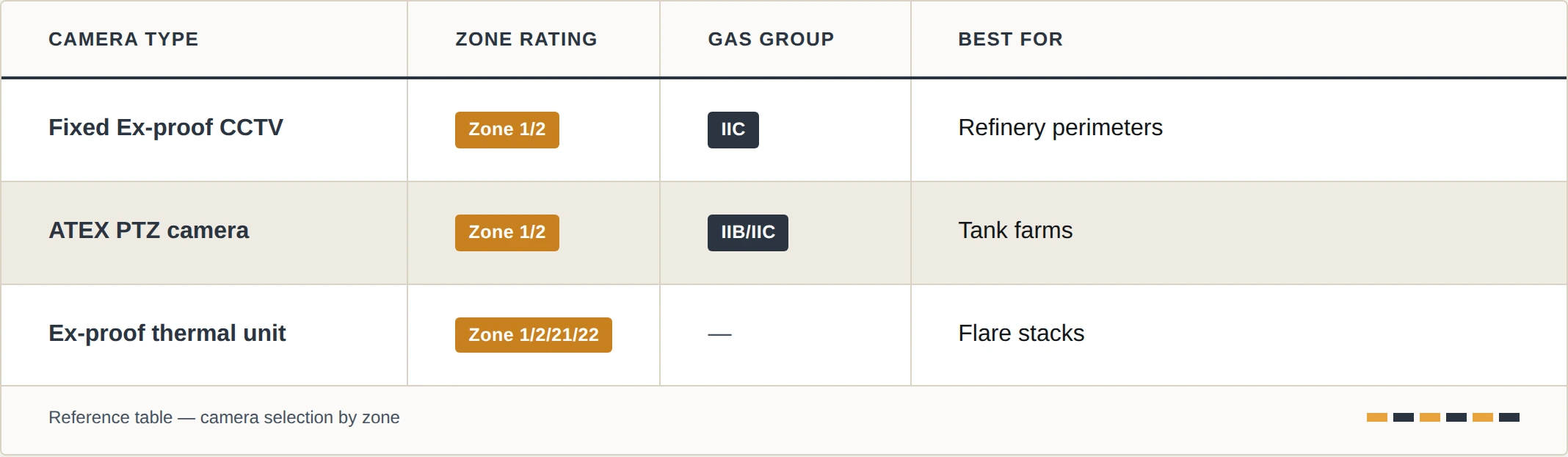
Maintenance, Inspection, and Compliance Upkeep
Periodic inspection keeps certification valid. Unauthorized repairs, damaged seals, or non OEM batteries can void it, so keep documentation organised.
SharpEagle ATEX Explosion-Proof Digital Camera
With over 15 years supplying hazardous area safety systems across the UAE, Saudi Arabia, Kuwait, and the GCC, SharpEagle's Ex-Proof Digital Camera is an ATEX approved handheld camera certified for Zone 1/2 gas and Zone 21/22 dust environments, suited to oil and gas, petrochemical, offshore, pharmaceutical, and mining.
SharpEagle Ex-Proof Digital Camera — Key Features
- Certifications - ATEX and IECEx certified
- Gas Compatibility - IIA, IIB, IIC
- Zone Rating - Zone 1/2, Zone 21/22
- Housing - Marine grade stainless steel
- Imaging - HD, 2MP, or 4MP
- Protection - Corrosion, dust, water resistant
Industry Applications: Oil refinery perimeters, offshore flare stacks, tank farms, loading bay CCTV, solvent storage, and mining conveyor surveillance.
Key Buyer Notes for HSE Managers: Always verify Equipment Group, Category, Gas Group, and T-Class rating. Group I covers mining, and Group II covers oil and gas, petrochemical, and energy; Zone 1 cameras should carry Group II Category 2G certification minimum.
Where Are Explosion-Proof Cameras Required in the UAE?
The UAE Fire and Life Safety Code, ADNOC, and DEWA standards require ATEX approved CCTV cameras and other hazardous area-certified equipment in classified zones, with ATEX certification UAE acceptance across GCC projects. Affected industries include oil and gas, petrochemical, offshore marine, pharmaceutical, paint, and grain processing. HSE teams must classify zones, match certificates, and keep records for audits.
How to Choose the Right ATEX Camera — Buyer Checklist
- Zone Classification — gas (0/1/2) or dust (20/21/22)
- Gas Group — match certification to site gases, IIA, IIB, or IIC
- Temperature Class — surface temperature below ignition threshold
- Housing/IP Rating — IP66+ with anti-corrosion protection offshore
- Certificate Verification — verify documentation with the issuing authority
Conclusion
Choosing the right ATEX rated camera means matching the zone, gas group, and temperature class to your site, then verifying certification before you buy.
Contact SharpEagle Technology for a no-obligation technical consultation.
