

Summary
Introduction
- Growing need for advanced surveillance in hazardous environments
- Limitations of fixed cameras in large explosive zones
- Introduction to Explosion Proof PTZ Type Dome Cameras
- Purpose of this guide: safety, flexibility, and compliance
What Is an Explosion Proof PTZ Type Dome Camera?
- Definition and core functionality
- Understanding pan, tilt, and zoom (PTZ) movement
- Difference between fixed and PTZ explosion-proof cameras
- Typical hazardous-area use cases
Why PTZ Cameras Are Critical in Hazardous Areas
How Does an Explosion Proof PTZ Dome Camera Work?
- Explosion-proof and flameproof dome housing
- Internal PTZ motor mechanisms
- Safe heat dissipation and pressure containment
- Remote control and system integration
Key Features of Explosion Proof PTZ Dome Cameras
- ATEX / IECEx certified enclosure
- 360° pan, tilt, and optical zoom capability
- High-definition video quality
- Infrared (IR) or low-light performance
- Corrosion-resistant materials (SS316 / aluminium)
- Weatherproof and IP-rated design
Benefits of Using Explosion Proof PTZ Dome Cameras
- Flexible monitoring of hazardous zones
- Reduced blind spots and improved response time
- Lower infrastructure costs compared to multiple fixed cameras
- Enhanced security and process monitoring
- Long service life with minimal maintenance
Where Are Explosion Proof PTZ Dome Cameras Used?
- Oil & gas refineries and offshore platforms
- Chemical and petrochemical plants
- Power generation and utility facilities
- Hazardous warehouses and storage terminals
- Marine, port, and offshore environments
How to Choose the Right Explosion Proof PTZ Dome Camera
- Hazardous area classification (Zone 1 / Zone 2)
- Required zoom range and coverage area
- Environmental conditions (heat, corrosion, vibration)
- Integration with existing CCTV/VMS systems
- Indoor vs outdoor installation needs
Installation Best Practices
ATEX, IECEx & Hazardous Area Regulations
Real-World Applications & Use Cases
Conclusion
Summary
An explosion proof PTZ dome camera provides flexible, certified surveillance for hazardous environments where fixed cameras fall short. This guide explains how an explosion proof PTZ mini dome camera works, why PTZ is critical for wide-area monitoring, and what features matter most—ATEX/IECEx compliance, optical zoom, HD video, low-light performance, and rugged outdoor design. You’ll learn how to choose between Zone 1 and Zone 2 solutions, follow safe installation practices, maintain long-term reliability, and improve monitoring in oil & gas, chemical plants, ports, and storage terminals.
Let’s be real for a second.
In a hazardous environment, you don’t get the luxury of “maybe.”
Maybe the camera will capture it.
Maybe someone will notice it.
Maybe the incident won’t escalate.
Because in oil & gas yards, chemical processing areas, and fuel-handling terminals, one blind moment can become a costly shutdown—or worse, a serious safety event.
That’s why the conversation is shifting from “Do we have cameras?” to:
Do we have the right cameras for hazardous zones?
And when it comes to monitoring large explosive areas where fixed cameras can’t keep up, the solution is clear:
Explosion proof PTZ dome camera systems.
They don’t just record.
They move. They track. They zoom.
And they do it safely, inside certified housings designed for hazardous atmospheres.
This guide is your complete, practical walkthrough—written in a human way, not like a technical brochure. You’ll learn what these cameras are, how they work, where they’re used, and how to choose the right setup for Zone 1 and Zone 2.
Introduction
Growing need for advanced surveillance in hazardous environments
Industrial sites are evolving. They’re bigger, more automated, and more regulated than ever before. At the same time, risks have also grown:
- Larger perimeters to secure
- More critical assets to monitor
- More restricted zones with limited access
- Higher compliance pressure from audits and insurance requirements
Across the UK, UAE, and KSA, hazardous environments such as refineries, chemical plants, and terminals need surveillance that goes beyond “basic coverage.” They need systems that help teams detect, verify, and respond—fast.
That’s why demand is rising for advanced solutions like the hazardous area PTZ camera, designed to operate safely where standard electronics are not allowed.
Limitations of fixed cameras in large explosive zones
Fixed cameras are reliable, but they have one major limitation:
They can only see what they’re pointed at.
In large hazardous zones, that creates problems like:
- Blind spots behind tanks, pipes, or structural columns
- Missed incidents happening outside the camera angle
- Too many cameras needed to cover one area
- Higher infrastructure cost due to extra mounts and cabling
So the site ends up with “coverage”… but not control.
Introduction to Explosion Proof PTZ Type Dome Cameras
An explosion proof PTZ dome camera changes the game because it gives you control.
Instead of installing 6 cameras to cover 6 angles, you can use one PTZ to scan, track, and zoom in on what matters—without sending anyone physically into danger.
This is especially valuable in explosive zones where access may be restricted or delayed due to safety procedures.
Purpose of this guide: safety, flexibility, and compliance
This guide will help you understand how an explosion proof PTZ camera improves:
- Safety through certified hazardous operation
- Flexibility through remote pan/tilt/zoom
- Compliance through ATEX and IECEx requirements
By the end, you’ll know exactly what to look for, what mistakes to avoid, and how to make a confident decision for your site.
What Is an Explosion Proof PTZ Type Dome Camera?
Definition and core functionality
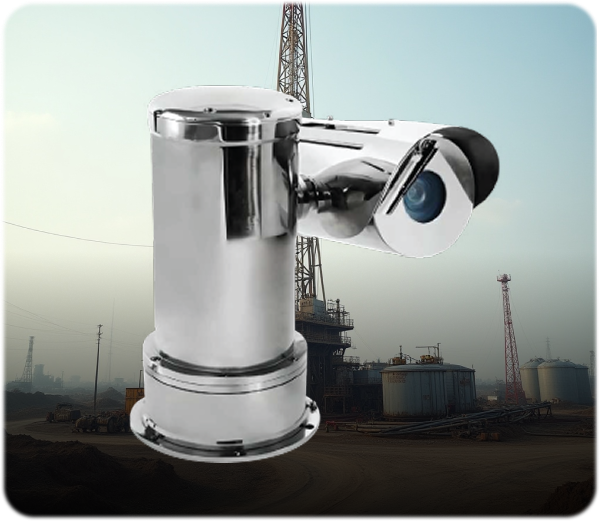
An explosion proof PTZ dome camera is a motorised surveillance camera designed for hazardous environments, housed inside a flameproof enclosure that prevents ignition risk. It allows operators to remotely pan, tilt, and zoom to monitor wide zones and focus on details.
In simple terms:
It’s a camera built for explosive atmospheres that can look around like a human eye—only sharper, faster, and safer.
Understanding pan, tilt, and zoom (PTZ) movement
PTZ movement is what makes these cameras so powerful:
- Pan: rotates left and right (often up to 360°)
- Tilt: moves up and down to change vertical angle
- Zoom: magnifies distant objects for detail viewing
This is why it’s also called an explosion proof pan tilt zoom camera—because the movement capability is the core advantage.
Difference between fixed and PTZ explosion-proof cameras
Both fixed and PTZ cameras can be explosion-proof. The difference is what they can do after installation.
A fixed explosion proof camera gives you one angle.
A PTZ version gives you multiple angles and zoom control.
Fixed cameras are great for constant viewing of one location.
PTZ cameras are ideal for wide areas, active monitoring, and incident response.
Typical hazardous-area use cases
Explosion proof PTZ dome cameras are commonly used in:
- Oil refinery yards
- Offshore platforms
- Tank farms and storage terminals
- Chemical processing areas
- Ports and marine environments
- Hazardous warehouses
Anywhere large zones need active monitoring, a PTZ explosion proof CCTV camera becomes a strong fit.
Why PTZ Cameras Are Critical in Hazardous Areas
Wide-Area Monitoring
Covering large zones with a single camera
Imagine a tank farm with multiple rows, access lanes, and restricted zones.
A fixed camera covers one direction.
But a PTZ can scan the entire area, giving security teams the ability to monitor movement dynamically.
That’s why a hazardous area PTZ camera is often selected for:
- Perimeter coverage
- Yard surveillance
- Tank corridor monitoring
- Loading and unloading zones
Reducing the number of cameras required
In many cases, PTZ reduces the need for multiple fixed cameras because it can:
- Replace several angles with one moving camera
- Reduce mounting points
- Reduce cabling complexity
- Lower installation time
It’s not just a camera upgrade—it can be a design upgrade.
Enhanced Situational Awareness
Zooming into incidents without physical access
Hazardous zones don’t allow quick physical inspection.
If something looks wrong, you may need to confirm from a distance.
With an explosion proof PTZ camera, you can zoom into:
- A suspicious person near a restricted area
- A valve zone showing unusual activity
- A loading bay where movement is unexpected
- A process area that looks abnormal
And you can do it without putting a worker at risk.
Remote monitoring of critical processes
Many facilities also use PTZ for process monitoring.
Not everything is about security. Sometimes it’s about:
- Operational visibility
- Detecting unusual movement patterns
- Monitoring restricted work zones
- Supporting investigation and reporting
Safety and Compliance Benefits
Eliminating ignition risks
Hazardous zones demand certified equipment. A standard camera may generate heat or spark risk during faults.
A certified ATEX PTZ camera or IECEx PTZ camera is built specifically to prevent ignition in explosive atmospheres.
Supporting regulatory and insurance requirements
Certified surveillance helps with:
- Audit readiness
- Insurance compliance
- Safety documentation
- Site-wide risk reduction plans
In high-risk industries, compliance is not “optional.” It’s survival.
How Does an Explosion Proof PTZ Dome Camera Work?
Explosion-proof and flameproof dome housing
The heart of an explosion proof PTZ system is its housing.
This dome enclosure is designed to:
- Contain internal sparks or ignition
- Prevent flame escape
- Protect electronics in explosive atmospheres
- Maintain safe operation in hazardous zones
This is what makes it different from a standard PTZ camera.
Internal PTZ motor mechanisms
Inside the housing, PTZ motors control:
- Pan rotation
- Tilt movement
- Zoom adjustment
The camera can be controlled remotely through a CCTV control room or VMS system.
Safe heat dissipation and pressure containment
Heat is a major hazard in explosive environments.
Explosion proof housings are engineered for:
- Safe thermal management
- Pressure containment
- Stable long-term operation
That’s why these are not “regular cameras with metal casing.”
They’re certified safety devices.
Remote control and system integration
A PTZ explosion proof CCTV camera typically integrates with:
- NVR systems
- CCTV control rooms
- Video management software (VMS)
- Industrial monitoring platforms
This allows operators to monitor large zones from a safe location.
Key Features of Explosion Proof PTZ Dome Cameras
ATEX / IECEx certified enclosure
This is the first thing to check.
A camera may look strong, but if it’s not certified, it may not be allowed in hazardous zones.
That’s why ATEX PTZ camera and IECEx PTZ camera certifications are critical.
360° pan, tilt, and optical zoom capability
The best PTZ cameras deliver:
- Smooth pan rotation
- Stable tilt control
- Strong optical zoom for distance monitoring
This is essential for wide-area hazardous surveillance.
High-definition video quality
HD video ensures that zoomed footage stays usable.
In real operations, you need to see:
- Faces and uniforms
- Vehicle numbers
- Equipment movement
- Unusual activity patterns
Infrared (IR) or low-light performance
Hazardous environments don’t sleep.
Night shifts, dim corridors, and outdoor zones require strong low-light performance.
Many sites prefer PTZ cameras with IR or low-light enhancement for 24/7 monitoring.
Corrosion-resistant materials (SS316 / aluminium)
If your camera is installed offshore or near chemicals, corrosion resistance becomes a major factor.
SS316 is often selected for marine and harsh environments due to high resistance.
Weatherproof and IP-rated design
For outdoor monitoring, IP-rated design helps protect against:
- Dust
- Rain
- Humidity
- Temperature changes
That’s why an explosion proof outdoor PTZ camera is essential for open yards and exposed sites.
Benefits of Using Explosion Proof PTZ Dome Cameras
A explosion proof PTZ dome camera is not just a “security upgrade.” It’s a site-wide visibility upgrade.
Flexible monitoring of hazardous zones
You can monitor multiple directions with one camera, making surveillance more dynamic and responsive.
Reduced blind spots and improved response time
When operators can move and zoom the camera, they can confirm incidents faster—without delay.
Lower infrastructure costs compared to multiple fixed cameras
Fewer cameras can mean:
- Less mounting hardware
- Less cabling
- Less installation work
- Less long-term maintenance
Enhanced security and process monitoring
A strong PTZ setup supports both:
- Security detection and tracking
- Operational monitoring and safety verification
Long service life with minimal maintenance
With rugged construction and certified design, explosion proof PTZ cameras are built for long-term performance in harsh industrial environments.
Where Are Explosion Proof PTZ Dome Cameras Used?
Oil & gas refineries and offshore platforms
An oil and gas PTZ camera is used to monitor:
- Tank farms
- Loading zones
- Restricted process areas
- Offshore access points
Chemical and petrochemical plants
A chemical plant PTZ camera supports monitoring of:
- Storage areas
- Restricted corridors
- High-risk operational zones
- Perimeter security
Power generation and utility facilities
PTZ cameras help monitor fuel handling areas and critical operational zones with wide coverage.
Hazardous warehouses and storage terminals
Storage terminals require continuous monitoring for security and safety compliance.
Marine, port, and offshore environments
Marine sites benefit from corrosion-resistant PTZ systems that handle humidity and salt exposure.
How to Choose the Right Explosion Proof PTZ Dome Camera
Hazardous area classification (Zone 1 / Zone 2)
This is the first selection step.
A Zone 1 PTZ camera is used where explosive atmospheres are likely during normal operation.
A Zone 2 PTZ camera is used where explosive atmospheres are less likely and occur briefly.
Always match certification to your site classification.
Required zoom range and coverage area
Ask yourself:
- How far do you need to see?
- Are you monitoring open yards or close process zones?
- Do you need detail identification or general tracking?
Environmental conditions (heat, corrosion, vibration)
Consider your site reality:
- Extreme heat
- Vibration near heavy equipment
- Chemical exposure
- Marine corrosion
Choose the right housing material and IP rating.
Integration with existing CCTV/VMS systems
The camera should work smoothly with your current system to avoid unnecessary upgrades.
Indoor vs outdoor installation needs
For outdoor zones, an explosion proof outdoor PTZ camera is usually required due to exposure and weather.
Installation Best Practices
Explosion proof installations should always follow certified procedures.
Mounting should be stable and designed for industrial environments. Cabling should use certified glands and conduit selection suitable for hazardous areas. Positioning should be planned for maximum coverage with minimal obstructions.
After installation, safety and functionality checks are critical. PTZ movement should be tested, zoom clarity confirmed, and integration verified.Maintenance & Inspection Guidelines
Routine inspection helps keep the system reliable.
Check dome housing condition, seals, and corrosion status regularly. PTZ movement should be tested to ensure smooth pan, tilt, and zoom performance. Dome covers should be cleaned carefully to maintain image clarity.
Maintaining inspection records is also important for compliance and audit readiness.
ATEX, IECEx & Hazardous Area Regulations
ATEX and IECEx certifications confirm equipment suitability for explosive atmospheres.
Across the UK, UAE, and KSA, hazardous area compliance expectations are strict—especially in oil & gas and petrochemical sectors.
Common mistakes include selecting the wrong zone-rated camera, using non-certified accessories, and skipping documentation.
Real-World Applications & Use Cases
In oil refineries, PTZ cameras are often used for wide-area yard surveillance where operators need to scan and zoom without entering restricted zones.
In chemical plants, PTZ cameras support process monitoring and after-hours surveillance, helping teams respond faster to abnormal activity.
Many sites also see improved incident response because operators can verify situations quickly and direct teams accurately.
Conclusion
When you operate in hazardous environments, you don’t just need surveillance—you need certified visibility.
An explosion proof PTZ dome camera delivers flexible monitoring, wide coverage, and safe performance in Zone 1 and Zone 2 areas. It reduces blind spots, improves response time, and supports compliance requirements with ATEX and IECEx certification.
Explore Explosion Proof PTZ Dome Cameras to strengthen hazardous area monitoring.
Request a hazardous area surveillance assessment to plan the right coverage.
Contact SharpEagle for certified solutions built for real industrial environments.
SharpEagle Technology offers ATEX-certified Explosion Proof PTZ Camera across the UAE, Saudi Arabia, Oman, Kuwait, Bahrain, and Qatar. Built for the most demanding and hazardous areas, our solutions ensure uncompromised safety, reliable performance, and adherence to global compliance standards. With an expanding international presence, we empower industries worldwide with intelligent and future-ready monitoring systems.