

Summary
Key Takeaway
Introduction
Why Standard CCTV Cameras Fail in Hazardous Environments
ATEX vs IECEx: Decoded for Procurement
Zone Classification Primer for UAE Facilities
8-Point Buying Checklist for Explosion Proof CCTV Cameras
Common Specification Mistakes That Cost UAE Projects
SharpEagle Explosion Proof Cameras: Brand Introduction
Conclusion
Summary
Choosing the right explosion proof CCTV camera UAE facilities can trust isn't about picking the most expensive option. It's about matching certification, zone classification, and gas group to your actual site conditions. This guide breaks down ATEX and IECEx standards, decodes confusing marking codes, and gives facility managers a practical checklist to avoid the procurement mistakes that lead to compliance failures and, worse, real safety incidents.
Key Takeaway
- Explosion-proof CCTV cameras are essential in hazardous UAE environments because standard cameras can fail due to heat, humidity, electrical arcs, or poor sealing.
- ATEX and IECEx certifications help ensure camera safety and compliance, especially for refineries, chemical plants, tank farms, and ADNOC-related projects.
- Zone classification must come before camera selection, as Zone 0, Zone 1, and Zone 2 areas require different protection levels and camera specifications.
- Buyers should verify certificate numbers online and reject photocopied or unclear certification documents to avoid compliance and safety risks.
- Common mistakes include confusing IP rating with explosion-proof certification, using uncertified cable glands, and installing Zone 2 cameras in Zone 1 areas.
- A reliable supplier should provide certified products, UAE-based technical support, site surveys, installation guidance, and maintenance records for long-term safety and compliance.
Introduction
It was 2 a.m. when the gas detector on a refinery's Zone 1 processing deck registered a spike. The control room operator looked up at the monitor bank expecting live footage. Instead, there was static. The camera covering that section had failed weeks earlier, unable to survive the heat and humidity cycling typical of a Gulf Coast facility. Nobody had flagged it because on paper it looked fine. It simply was not built for where it was installed.
Industrial fires and explosions cost economies across the GCC billions of dollars every year, and inadequate surveillance is often a silent enabler of those losses. When something goes wrong in a hazardous zone, the camera meant to capture it is sometimes the first piece of equipment to fail. For UAE facility managers this is also a compliance pressure point under ADNOC HSE standards and the UAE Fire and Life Safety Code, both of which expect surveillance equipment in hazardous areas to meet recognised explosion protection standards.
This article is not a product catalogue. It is a practical ATEX and IECEx buying framework for specifying an explosion proof CCTV camera UAE sites can rely on and for comparing one hazardous area camera UAE vendor against another before signing a purchase order.
Why Standard CCTV Cameras Fail in Hazardous Environments
To understand why certification matters, it helps to understand the physics involved. Inside a typical camera, small motors and circuit boards generate heat and can produce tiny electrical arcs during normal operation. In a hazardous area where flammable gases or combustible dust are present, an arc flash or a hot surface can act as an ignition source. Standard camera motors and PCBs can exceed the ignition threshold of common hydrocarbons, which is why a generic industrial CCTV camera UAE facilities might otherwise consider is unsuitable for these zones.
This is where gas group classification matters. IIA covers substances such as propane, IIB covers gases like ethylene, and IIC covers the most easily ignited substances, including hydrogen and acetylene. Camera housing material and sealing method both need to correspond to the gas group present on site, since a unit built for IIA gases has no business sitting near a hydrogen line. This is also why specifying an Ex proof CCTV Camera UAE engineers can sign off on matters more than choosing the cheapest industrial CCTV camera UAE distributor catalogues happen to feature.
The consequences of ignoring this are not theoretical. Equipment that does not conform to IEC 60079 and EN 13463 can void insurance, breach UAE OHS regulations, and create personal liability for the approving safety manager. In the field, non-certified units commonly fail through condensation breach in unsealed housings, static discharge from polycarbonate domes, or overheating once desert ambient temperatures climb past 50 °C.
ATEX vs IECEx: Decoded for Procurement
Once the risk is clear, the next hurdle is understanding which certification scheme applies and what each one actually certifies.
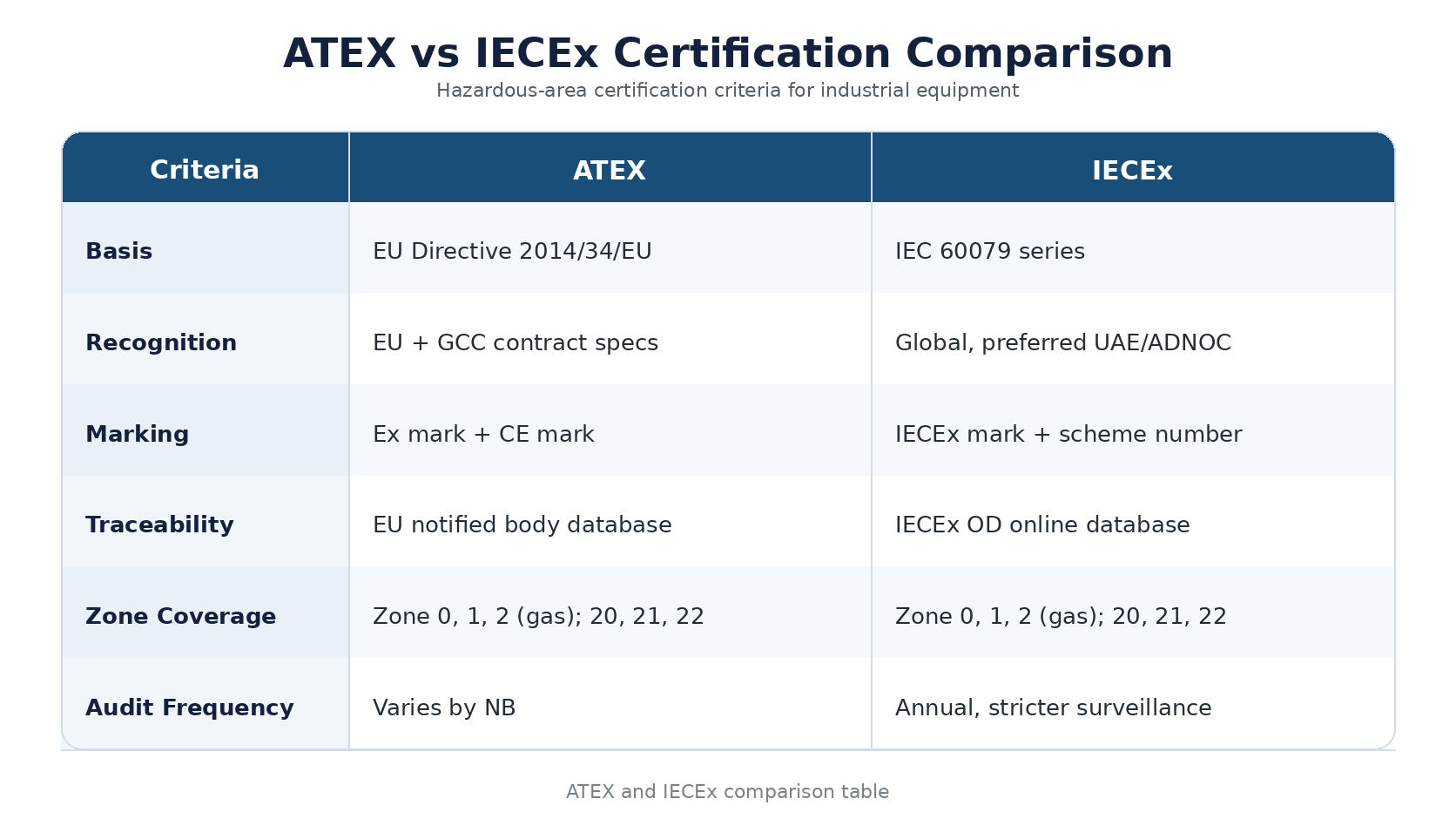
ATEX, short for Atmosphères Explosibles, is the framework established under EU Directive 2014/34/EU. It is mandatory across the EU and widely recognised in GCC project specs and EPC contracts. Many UAE tenders simply ask for an ATEX CCTV camera UAE supplier can document end-to-end, certificate included, rather than spelling out the full directive reference. IECEx, the IEC System for Certification to Standards Relating to Equipment for Use in Explosive Atmospheres, is a global scheme based on the IEC 60079 series, and it is the scheme generally preferred by ADNOC and other international projects.
 A real camera marking can look intimidating until you break it down. Take Ex. db IIC T6 Gb. The "d" tells you the protection concept is a flameproof enclosure. IIC is the gas group, meaning the unit is rated for the most demanding gases. T6 means a maximum surface temperature of 85 °C. Gb confirms suitability for Zone 1. Before signing off on any ATEX-certified CCTV camera or IECEx-certified camera, cross-reference the certificate number on the IECEx OD public database. Photocopied certificates should be rejected outright, whether the unit is presented as an ATEX certified CCTV camera or marketed under an IECEx certified camera listing.
Zone Classification Primer for UAE Facilities
Every hazardous area camera decision should start with zone classification, because the zone determines which protection concepts are acceptable in the first place.
Zone 0 and its dust equivalent, Zone 20, represent continuous hazard, and camera mounting here is rare but possible with Ex ia intrinsically safe units. Zone 1 and Zone 21 cover intermittent hazards, and this is where most UAE refinery production decks and chemical reactor areas fall. It is also the most common spec point for explosion proof CCTV camera UAE procurement, since these areas carry the most operational and regulatory weight. Zone 2 and Zone 22 cover infrequent hazards, typically tank farms and loading bays, and these areas are often well served by Ex ec or Ex nA rated cameras at lower cost.
Facility managers should commission a Hazardous Area Classification study per IEC 60079-10-1 before writing any camera specification. Cross reference this against existing P&ID drawings and SIL assessment records, since inconsistencies are common and create procurement errors. Document zone boundaries clearly on site drawings and attach them as an appendix to the camera procurement RFQ. This is the same documentation a serious ATEX CCTV camera UAE vendor will ask to see before recommending a specific Ex proof CCTV Camera UAE model, and it is what separates a genuine hazardous area camera UAE specialist from a general security distributor.
8-Point Buying Checklist for Explosion Proof CCTV Cameras
- Confirm Zone Classification: Match the camera's Equipment Protection Level to the site HAC study, not to a generic assumption about the area.
- Validate the Certification Mark: Verify ATEX and IECEx certificate numbers online and reject photocopied certificates.
- Check the Gas Group: IIC covers all gas groups but does not accept IIA or IIB rated units in hydrogen risk environments.
- Review the Temperature Class: T4 at 135 °C is the minimum for most hydrocarbons, while T6 at 85 °C is the safest choice for UAE refineries.
- Assess the IP Rating: IP66 should be the minimum for outdoor UAE installations, with IP68 reserved for below grade or washdown locations.
- Evaluate Operating Temperature Range: UAE ambient temperature can reach 50 °C, so the unit must be rated to at least 60 °C ambient without thermal throttling.
- Confirm Resolution & Low Light Performance: A minimum of 2 MP is advisable, with IR illumination limited to Ex rated IR LEDs only.
- Review Warranty, Spares & In Country Support: Certified equipment must be maintained by competent persons, so confirm genuine UAE service infrastructure exists before you buy.
This checklist applies whether you are sourcing an explosion proof surveillance camera for one control room or an industrial explosion proof camera rollout across multiple sites.
Common Specification Mistakes That Cost UAE Projects
A few recurring errors show up again and again in UAE procurement files.
Treating IP rating as a proxy for explosion proofing is the most common one. IP68 does not imply Ex certification. Specifying "ATEX approved" without stating the required Ex protection concept is another, since vague wording lets vendors substitute Ex nA units, suitable only for Zone 2, into Zone 1 locations where they should never go.
Ignoring cable gland certification is a quieter but equally serious mistake, since an uncertified gland breaches the Ex enclosure and voids the camera's certification entirely. The same applies to brackets and conduit: every field installed accessory must carry the same or higher Ex rating as the camera itself. Many facilities also fail to update the asset register once a unit is installed, even though IEC 60079-17 requires Ex cameras to appear in scheduled maintenance inspection records. Finally, accepting "equivalent" foreign certifications that are not mutually recognised is a risk not worth taking. For UAE government and ADNOC projects, always demand IECEx or ATEX certificates.
Whether you are evaluating Explosion proof security Cameras for a fixed perimeter or an Explosion proof PTZ camera UAE site needs for wider coverage, these same mistakes apply.
SharpEagle Explosion Proof Cameras: Brand Introduction
SharpEagle Technology was established in 2009 and has spent over 15 years delivering certified safety and security solutions across the UAE, KSA, UK, and Kuwait. SharpEagle's explosion proof CCTV camera UAE range carries dual ATEX and IECEx certification, covering Zone 1 and Zone 2 gas hazards as well as Zone 21 and Zone 22 dust hazards.
A few things set the range apart. There is a UAE based technical team for on site survey, installation sign off, and periodic inspection. Cameras are engineered for GCC climate, rated to 60 °C ambient, with IP66 and IP67 stainless steel housings built for heat, humidity, and dust. SharpEagle also supports full project lifecycle work, from HAC review and specification writing through supply, commissioning, and IEC 60079-17 maintenance records, with every unit compatible with major VMS platforms, including Milestone, Genetec, and Hikvision.
This range covers everything from a standard explosion proof camera for oil and gas UAE production decks to specialised builds. Clients sourcing through established explosion proof camera manufacturers' UAE projects depend on consistently landing on SharpEagle. Even teams searching for an Explosion proof IP Camera UAE networks can integrate directly will find that an explosion proof cctv camera UAE site engineer trusts is already built into the range.
Conclusion
Three steps decide whether a hazardous area camera project succeeds. Classify the zone. Match the certification. Validate the supplier. In the UAE's regulatory environment, under specified surveillance is a compliance liability and an operational safety gap, not a minor paperwork detail.
SharpEagle brings dual certified, climate engineered cameras together with a UAE based technical team supporting the full project lifecycle, from the first site survey through years of ongoing maintenance records.
📞 Contact SharpEagle today for a no obligation technical consultation.
