

Summary
Introduction
Why Forklift Visibility Is a Major Challenge in UAE Warehouses
What Is a ForkView Camera System?
How ForkView Camera Systems Work
Why UAE Warehouses Need ForkView Camera Systems
Key Benefits of ForkView Camera Systems
Key Features to Look for Before Buying
Why SharpEagle ForkView Camera Systems Stand Out
Applications Across UAE Industries
Common Buying Mistakes
Future Trends in Forklift Visibility Technology
Conclusion
Looking to Improve Forklift Visibility?
Summary
UAE warehouses are expanding fast, and operators are under pressure to move loads quickly and safely. This guide explains how a ForkView camera system UAE facilities are adopting solves the visibility problem at height, reduces product and rack damage, and helps logistics teams run tighter, safer operations without slowing down throughput.
Introduction
The UAE logistics sector has been growing at a remarkable pace. New warehousing facilities open across the country every year; online fulfilment centres are multiplying to keep up with e-commerce demand; and free zones and industrial parks continue attracting global supply chain operators.
With all this growth comes a challenge that rarely gets enough attention. Operators are being asked to lift pallets higher, move faster, and work in tighter spaces than ever before. When a forklift raises a load several metres into a racking system, the driver often cannot see exactly where the forks are or how the pallet is sitting, and poor visibility leads to product damage, rack damage, delays, and genuine safety risks.
A ForkView camera system UAE facilities are increasingly adopting solves this by giving operators a clear, live view of the forks and the load, removing much of the guesswork involved in working at height. This guide walks through why visibility is such a persistent problem in a forklift camera system UAE warehouse relies on daily, how the technology works, and what to look for before buying.
Why Forklift Visibility Is a Major Challenge in UAE Warehouses
Visibility shapes almost every part of daily warehouse operations, and a few recurring issues make it especially difficult.
High rack storage is probably the biggest culprit. As warehouses build upward to maximise floor space, operators regularly lift loads five, six, or even ten metres into the air, and at that height the mast and load block the driver's direct line of sight. Narrow aisles compound this, since many distribution centres are built with tight widths, leaving little room for error while manoeuvring. Blind load handling naturally follows, as operators rely on instinct or hand signals rather than what they can see. Fast paced operations add pressure too, since same day delivery commitments push drivers to move quickly, and speed without visibility is a recipe for mistakes.
The consequences add up quickly: damaged products, dented racking, slower cycle times, and near miss incidents. This is why more operations managers are looking closely at a forklift visibility system UAE teams can depend on, rather than treating poor visibility as an unavoidable cost of business. It also explains the growing interest in forklift operator visibility solutions built around real time cameras rather than guesswork.
What Is a ForkView Camera System?
A ForkView camera system UAE operators use is, at its core, a small industrial camera mounted directly on the forklift carriage, positioned to look along the forks and onto the load. Footage is sent to a monitor inside the cabin, giving the operator a continuous, close up view of exactly what the forks are doing.
This is quite different from a standard reversing camera, which helps a driver see behind the vehicle while travelling in reverse. A forklift fork camera UAE facilities install serves an entirely different purpose, staying fixed on the forks and pallet regardless of mast height, tilt, or direction of travel because it is built specifically for load handling. A forklift fork camera UAE teams choose for this purpose must survive constant vibration and dust while still delivering a stable picture at height.
How ForkView Camera Systems Work
The technology is simpler than many expect, and that simplicity is part of what makes it reliable. A compact camera unit mounts on the carriage so it moves with the forks rather than staying fixed to the mast frame. As the forks rise, lower, tilt, or extend, the camera follows the same movement, keeping the load in frame at all times.
The feed is sent wirelessly to the cabin monitor, so there is no cabling running along the mast that could snag or wear through. The operator glances at the screen while raising or lowering a load, and fork positioning becomes noticeably more precise.
A wireless forklift camera system is also quicker and cheaper to install than a wired alternative, since there is no need to run cable through the mast assembly. Combined with HD image quality, a forklift load camera system meaningfully reduces operator guesswork, particularly during high-rack put-away and retrieval tasks. Choosing a well-built forklift load camera system upfront tends to pay off through fewer damaged pallets and smoother shifts.
Why UAE Warehouses Need ForkView Camera Systems
The case for this technology becomes clear once you look at where it is used. Distribution centres rely on speed and accuracy, and a small placement error at height can delay an entire shift. Logistics hubs near major ports and airports handle a huge variety of pallet sizes, making consistent visibility important. Manufacturing facilities move raw materials and finished goods through the same aisles, adding complexity. Cold storage warehouses face condensation and dim lighting that make an operator's job harder. Retail fulfilment centres feel constant pressure from fast order cycles, where damaged stock affects customer satisfaction. Free zone operations, common across hubs like Jebel Ali, often run multi-shift patterns where consistency across drivers matters as much as speed.
Across Dubai, Abu Dhabi, Sharjah, Jebel Ali, and Ras Al Khaimah, the pattern is the same: as operations scale up, the margin for visibility-related error shrinks. A warehouse visibility solutions UAE facilities implement early tends to save far more in avoided damage than it costs to install, which is why a forklift visibility system UAE managers' trust has become part of standard fleet planning. Choosing the right warehouse visibility solutions UAE early also makes it easier to scale operations later.
Read More : Why Standard Forklift Cameras Fail in High Traffic Warehouses
Key Benefits of ForkView Camera Systems
Improved fork visibility is the most obvious benefit, since operators can finally see where the forks sit relative to the pallet at any height. Accurate pallet placement follows naturally, as drivers stop guessing where the forks enter a load. Reduced product damage is one of the most measurable gains; a team handling fragile electronics, for example, often reports fewer crushed cartons once fork placement can be seen clearly. Lower rack damage matters too, since a small correction in real time prevents the kind of impact that bends upright frames over months of use.
Increased productivity comes from operators spending less time repositioning loads, speeding up put away and retrieval cycles. Improved operator confidence is easy to overlook but genuinely important, and faster load handling follows from that confidence. Enhanced safety ties everything together, as clear downward visibility reduces collisions with racking or pedestrians nearby.
Together these benefits explain why a forklift load positioning camera is increasingly seen as a core part of forklift load handling safety in serious warehouse operations, not an optional extra.
Traditional Forklift Visibility Methods vs ForkView Cameras
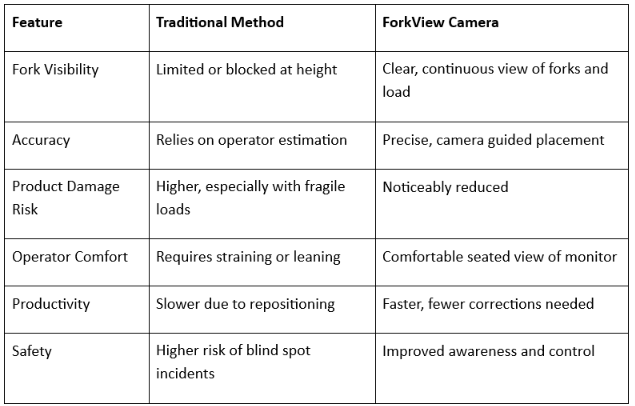 A forklift load positioning camera changes this equation almost immediately, since it removes the guesswork traditional methods depend on. Leaning out of the cabin or relying on mirrors and hand signals has obvious limits and depends heavily on individual experience. A forklift fork camera UAE team installs, removing much of that dependency by giving every operator, regardless of experience level, the same clear line of sight, which is why forklift operator visibility solutions built around real time cameras are steadily replacing older, manual approaches.
Key Features to Look for Before Buying
Not all camera systems are built the same, so it is worth knowing what separates an industrial grade solution from a basic aftermarket accessory. HD camera quality ensures operators can make out fine details like pallet edges and fork alignment. Wireless transmission removes cabling headaches and reduces the risk of damaged wires, and low latency video is essential since any noticeable lag can be more distracting than helpful.
Durable construction matters because forklifts operate in demanding conditions day after day, and IP69K protection indicates a unit can handle dust, moisture, and washdowns without failing. A wide viewing angle helps operators see the full width of a pallet, which matters most for a forklift camera for high racking application where every centimetre counts. Battery performance needs to hold up across a full shift, and easy installation keeps downtime to a minimum.
Given how harsh industrial environments can be, a genuinely reliable forklift safety camera UAE facilities choose almost always saves money over time compared with cutting corners on build quality. Skipping environmental ratings is a common mistake, since a forklift safety camera UAE conditions demand that they must withstand dust, heat, and washdowns without failing.
Read More : How Forklift Blue Light Safety Systems Improve Warehouse Safety in UAE
Why SharpEagle ForkView Camera Systems Stand Out
SharpEagle has built its ForkView camera system UAE customers rely on around the practical realities of daily warehouse work rather than as a simple add on gadget. The cameras deliver genuinely sharp HD video, so operators are not left interpreting a grainy image while placing a load several metres in the air. Wireless operation is standard, which keeps installation straightforward and avoids the cabling issues that plague some older setups.
Every unit is built with industrial grade housing designed to withstand the vibration, dust, and wear that comes with constant forklift use across busy UAE facilities. Durability is not an afterthought here, and these systems are engineered to keep performing reliably shift after shift, which matters far more than a spec sheet. It is easy to see why a forklift camera system UAE operators trust tends to come back to solutions built with these priorities in mind.
Applications Across UAE Industries
A forklift camera system UAE warehouses install pays off across almost every department. Warehousing benefits from fewer blind spots during put away and retrieval, particularly in tall racking. Logistics providers handling mixed pallet types gain consistency across load shapes and sizes. Manufacturing sites see fewer collisions between forklifts and stored materials. Retail distribution centres reduce stock damage that eats into margins during peak seasons. FMCG operations, where pallet turnover is constant, benefit from faster handling cycles, and cold storage facilities gain a clearer view even in the low light conditions typical of chillers and freezers.
Across each sector, a warehouse forklift camera system tends to deliver the same result: fewer errors, less damage, and steadier throughput, feeding into the broader warehouse productivity solutions operations managers are actively looking for. Facilities running more than one shift often see the biggest gains from a warehouse forklift camera system, simply because consistency across drivers matters more at scale.
Common Buying Mistakes
A few recurring mistakes tend to undermine the value of these systems even after installation. Choosing low resolution cameras to save on upfront cost often backfires once operators struggle to make out fine detail at height. Ignoring wireless performance can leave you with a signal that drops or lags in busier facilities, and poor camera placement reduces the practical field of view even with good hardware. Buying non industrial equipment rarely survives daily forklift vibration and dust, ignoring environmental ratings like IP69K can lead to early failure, and selecting limited viewing angles leaves gaps in what the operator can actually see, defeating much of the point of installing a system at all.
Future Trends in Forklift Visibility Technology
Visibility technology is not standing still. AI powered vision systems are beginning to layer object recognition and automatic alerts on top of standard camera feeds, helping flag potential collisions before they happen. Smart warehouses are increasingly connecting camera systems into broader fleet management platforms, giving supervisors visibility across an entire operation rather than one vehicle at a time. Connected forklift fleets are starting to share data between vehicles, and advanced camera analytics are being used to spot patterns in near misses or repeated handling issues. As Industry 4.0 principles spread through UAE logistics and manufacturing, camera based visibility is becoming one of several connected tools working together, and any forklift visibility system UAE facilities adopt today will likely plug into these larger platforms tomorrow.
Read More : Why Manufacturing Plants Are Adopting Forklift Camera Systems
Conclusion
Visibility at height remains one of the most persistent challenges in modern warehouse operations, and the cost of ignoring it shows up in damaged products, dented racking, and slower cycle times. A ForkView camera system UAE facilities install gives operators the clear, real time view they need to place loads accurately, work with more confidence, and move through their shifts more safely. As UAE warehouses continue to scale, investing in reliable visibility technology is quickly becoming less of a nice to have and more of a practical necessity for any serious logistics operation.
Looking to Improve Forklift Visibility?
Looking to improve forklift visibility and reduce product damage? Speak with SharpEagle's warehouse safety specialists to discover how ForkView camera systems can improve load handling accuracy, enhance safety, and increase productivity across your operations.
