

Summary
Section 1: The Reality of Monitoring Explosive Hazard Zones
Why Standard Cameras Fail in Hazardous Zones
Section 2: SharpEagle Explosion-Proof Cameras — Built for the Most Dangerous Places on Earth
Key Features of the SharpEagle Explosion-Proof Camera Range
Real-World Applications
The Role of Explosion Proof Cameras
Conclusion: Don't Let the Next Incident Go Unwitnessed
Summary
Working in hazardous environments — oil refineries, chemical plants, mining sites, and gas pipelines — puts lives at risk, especially during explosive incidents. Remote monitoring with explosion-proof cameras has become the industry standard for capturing critical events safely. SharpEagle's certified explosion-proof camera range delivers high-definition, real-time footage from the most dangerous zones on the planet, empowering safety teams to respond faster, investigate incidents thoroughly, and protect their workforce — all without direct human exposure to danger.
Section 1: The Reality of Monitoring Explosive Hazard Zones
Industrial facilities handling flammable gases, volatile chemicals, and combustible dust are inherently unpredictable. One spark in the wrong place can trigger a catastrophic chain reaction. Traditional monitoring strategies — deploying human observers or using standard CCTV systems — are not only insufficient but dangerously inadequate in these environments.
The consequences are stark: delayed incident detection, incomplete event documentation, and worst of all, preventable injuries and fatalities. Industries including oil & gas, petrochemicals, mining, and pharmaceuticals face mounting regulatory pressure to demonstrate robust real-time monitoring of hazardous areas. The solution is unambiguous — remote visual monitoring using certified explosion-proof cameras.
Why Standard Cameras Fail in Hazardous Zones
Conventional surveillance cameras are not engineered to operate within explosive atmospheres. Even a minor electrical arc or heat buildup inside the camera housing can act as an ignition source, creating the very disaster the camera was meant to observe. Beyond safety risks, standard cameras fail operationally in extreme conditions:
• Dust infiltration degrades lenses and internal components
• High humidity and corrosive gases cause rapid hardware failure
• Wide temperature swings cause fogging, condensation, and electronics damage
• High-pressure washdowns destroy unsealed enclosures
What hazardous sites demand is a camera engineered from the ground up to withstand these conditions — one that is intrinsically safe, hermetically sealed, and built to international explosion-protection standards.
Section 2: SharpEagle Explosion-Proof Cameras — Built for the Most Dangerous Places on Earth
SharpEagle has spent years engineering a comprehensive range of explosion-proof cameras specifically designed for Zone 1, Zone 2, Zone 21, and Zone 22 classified hazardous areas. Every hazardous area camera in the SharpEagle range is certified to ATEX and IECEx standards, giving safety managers and compliance officers the confidence that their monitoring infrastructure meets the strictest global requirements.
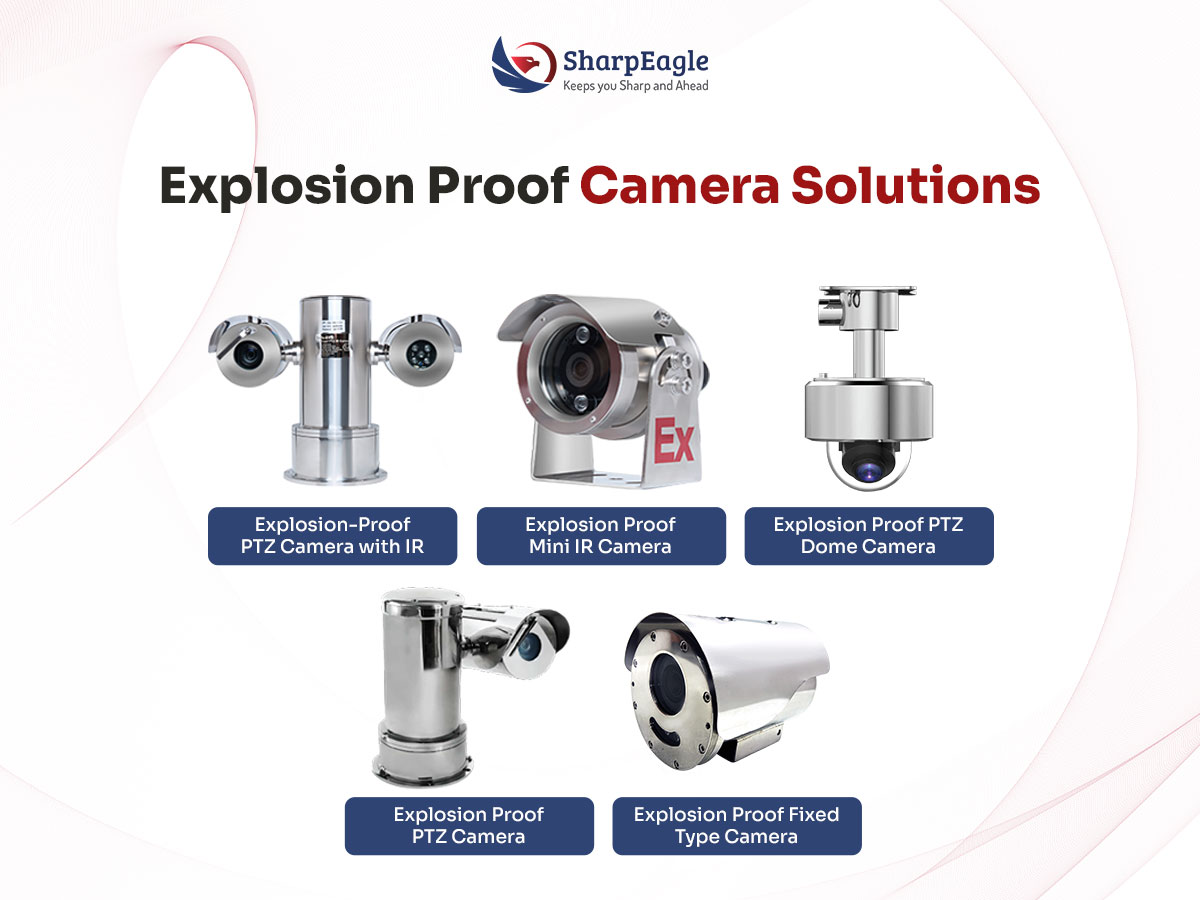
Key Features of the SharpEagle Explosion-Proof Camera Range
• ATEX & IECEx Certified — Globally recognised certifications for use in explosive atmospheres (gas, vapour, and dust environments)
• IP66/IP67/IP68 Rated Enclosures — Complete protection against dust ingress and high-pressure water jets, making them suitable for offshore platforms, refineries, and underground mines
• High-Definition Imaging — Full HD and 4K resolution options ensuring fine detail is captured even in low-light or smoke-filled conditions
• Infrared Night Vision — Onboard IR illuminators enable clear footage in complete darkness, essential for 24/7 monitoring of remote equipment and storage areas
• PTZ (Pan-Tilt-Zoom) Capability — Remotely operated PTZ models allow operators to scan large areas, track incidents in real time, and zoom into critical events from a control room
• Wide Temperature Range — Engineered to operate in temperatures from -40°C to +70°C, covering arctic pipelines to desert refineries
• Anti-Corrosion Marine-Grade Housing — Stainless steel and aluminium alloy housings resistant to chemical exposure, saltwater, and industrial cleaning agents
• PoE & Analogue Connectivity — Flexible integration with existing IP network infrastructure or legacy analogue systems
"SharpEagle cameras are not just explosion-proof — they are mission-critical devices engineered for the exact moment everything is on the line."
Real-World Applications
The SharpEagle explosion-proof camera range is actively deployed across the world's most demanding industrial environments:
• Oil & Gas Refineries — Monitoring pump stations, flare stacks, and storage tank farms
• Offshore Platforms — Withstanding salt spray, humidity, and structural vibration in marine environments
• Chemical & Pharmaceutical Plants — Continuous surveillance of reactors, mixing vessels, and solvent storage areas
• Mining Operations — Underground and open-cast monitoring in dust-laden and gas-prone tunnels
• Power Generation Facilities — Monitoring turbine halls, transformer bays, and fuel handling areas
• Grain & Agricultural Storage — Protecting against combustible dust hazards in silos and processing facilities
In each of these scenarios, SharpEagle cameras serve a dual purpose: enabling proactive hazard detection before an incident escalates and providing critical forensic-quality footage after an event for investigation, insurance, and regulatory reporting.
The Role of Explosion Proof Cameras
Explosion proof cameras are specifically designed to operate safely in hazardous areas. They are built with:
- Flameproof enclosures
- Corrosion-resistant materials
- High-temperature tolerance
- Certified compliance (ATEX, IECEx)
These cameras ensure continuous monitoring without becoming a source of ignition.
Conclusion: Don't Let the Next Incident Go Unwitnessed
The cost of inadequate monitoring in a hazardous environment cannot be measured only in equipment damage — it is measured in human lives, regulatory penalties, operational downtime, and irreparable reputational harm. The technology to monitor your most dangerous sites remotely, safely, and reliably exists today.
SharpEagle's explosion-proof camera range delivers the combination of certified safety, uncompromising image quality, and industrial-grade durability your operations demand. Whether you are upgrading an existing surveillance system or building safety infrastructure for a new facility, SharpEagle has the right solution for your hazardous area classification.
Investing in explosion-proof remote monitoring is not simply a compliance exercise — it is a fundamental commitment to the safety of your people, your assets, and your operations.
Protect Your Site With SharpEagle Explosion-Proof Cameras
Explore the full SharpEagle explosion-proof camera range and speak to a hazardous area specialist today.
