

Summary
Understanding Hazardous Environments: Where ATEX Cameras Are Non-Negotiable
Decoding ATEX Certification: More Than Just a Label
ATEX Camera Protection Types: How to Choose the Right One
- A. Explosion-Proof Cameras
- B. Intrinsically Safe Cameras
- C. ATEX Camera Housings
- D. Thermal / Infrared ATEX Cameras
- Non‑Negotiable Features for ATEX Cameras
- A. Durability & Materials
- B. Temperature Management
- C. Imaging Performance
- D. Connectivity
Selecting the Right ATEX Camera: A Step‑by‑Step Guide
Installation & Maintenance: Protecting Your Investment
ATEX or IECEx in the UAE and Saudi Arabia: What Site Owners Accept
Buyer checklist for an ATEX rated camera
- Top ATEX Camera Brands: Models & Price Comparison
- SharpEagle’s ATEX Camera Series & Use Cases
- Explosion‑Proof Mini IR Camera
- Explosion‑Proof PTZ Camera
- Fixed Type Dome Camera
- Explosion‑Proof Digital Camera (Portable)
SharpEagle's Business Model & After‑Sales Advantage
Summary
This extensive guide explores atex approved camera certification and protection strategies for hazardous environments like oil refineries, chemical plants, and mining operations. We begin by explaining hazard zones, ATEX legal frameworks, and real-world implications of non-compliance. Next, we unpack different ATEX Certified Camera designs, flameproof, intrinsically safe, retrofit housings, and thermal/infrared systems.
In industries filled with flammable gases, vapors, or dust, a single spark, sometimes from a camera, can trigger a catastrophic explosion. Traditional monitoring equipment may unintentionally ignite dangerous atmospheres. ATEX zones mitigate this risk with explosion-proof engineering. Named from “ATmosphères EXplosibles,” ATEX certifications are mandatory in EU-specified environments.
SharpEagle Technology, founded in 2009 in the UK, has grown to support UK, Middle East, with full-solution package deals: consultation, design, delivery, installation, and ongoing service.
Our mission: empower industries to operate safely and productively, ensuring workers go home without harm. This guide equips safety managers, plant engineers, and procurement teams in the UK, UAE, and KSA with actionable knowledge, sharpening your camera choices to align with compliance needs.
Understanding Hazardous Environments: Where ATEX Cameras Are Non-Negotiable
Defining Hazardous Areas
As categorized by ATEX 1999/92/EC, hazardous zones contain flammable materials in concentrations likely enough to cause explosion. Examples include:
- Flammable gases/vapors (e.g., methane, hydrogen)
- Combustible dusts (e.g., coal, grain)
- Ignitable fibers (e.g., textile, wood dust)
ATEX Zone Classifications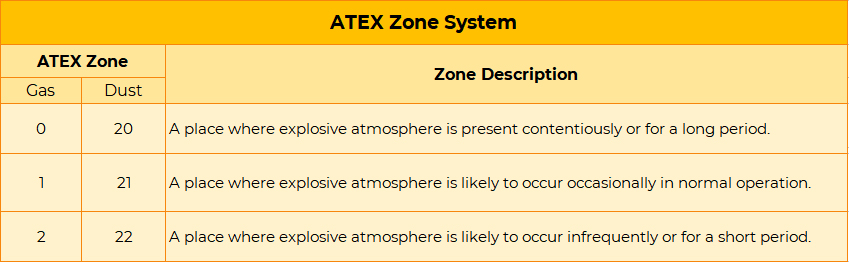 Real-World Incident
A 2023 accident at a Saudi refinery involved a gas explosion traced back to a non-ATEX thermal camera used in Zone 1. Damaged equipment cost ~$2 million and halted production for a month. Proper ATEX devices would have averted this disaster.
Decoding ATEX Certification: More Than Just a Label
Legal Framework
- ATEX 2014/34/EU (Equipment): Requires device design per explosion-proof criteria.
- ATEX 1999/92/EC (Workplace): Obligates employers to match tools to zone risk.
Marking Breakdown
- Example: Ex db IIC T4 Gb means
- Ex: Explosion-proof
- db: Flameproof enclosure
- IIC: Suitable for hydrogen‑rich atmospheres
- T4: Surface temp ≤135 °C
- Gb: Certified for Zone 1
An ATEX rated camera and an ATEX certified camera are the same thing: a camera whose marking has been verified by a notified body against the directive, with the certificate number printed on the housing label. When buyers compare ATEX cameras, the marking above is the comparison: the equipment category and protection level fix the zones, the gas group fixes which substances are covered, and the temperature class must sit below the ignition temperature of the process. A camera marked II 2G Ex db IIC T6 Gb, for example, is a Zone 1 and Zone 2 unit for every gas group with a surface temperature that stays below 85 degrees C.
ATEX Camera Protection Types: How to Choose the Right One
A. Explosion-Proof Cameras
These cameras are designed with heavy-duty flameproof housings, usually stainless steel (304/316L). The housing ensures that if an internal spark or explosion occurs, it will be contained inside and not ignite the surrounding atmosphere.
- Best suited for: Zone 1 areas with toxic gases or flammable vapors.
- Considerations: They are quite large and heavy (up to ~15 kg), which reduces mobility but makes them very durable.
- Example: SharpEagle PTZ cameras that come with pan/tilt/zoom control, infrared (IR) for night vision, IP68 protection, and ATEX certification for Zone 1/2.
B. Intrinsically Safe Cameras
Instead of relying on heavy enclosures, these cameras are designed to limit internal electrical energy so that even in the event of a fault, they cannot generate sparks or heat that could ignite hazardous gases or dust.
- Best suited for: The highest-risk areas such as Zone 0/20, or confined spaces where gases may always be present.
- Considerations: More compact and portable compared to flameproof cameras.
- Example: SharpEagle’s explosion-proof digital camera, shock-proof (withstands 2.4 m drops), waterproof (up to 30 m depth), freeze-proof (–10 °C), and equipped with 5× optical + 4× intelligent zoom.
C. ATEX Camera Housings
This is not a standalone camera but rather an enclosure system. A standard commercial camera is placed inside an explosion-proof housing, making it compliant for use in Hazardous Area Camera zones.
- Best suited for: Projects on a budget, or temporary installations where specialized explosion-proof cameras are not feasible.
- Considerations: While cost-effective, they may limit advanced optical features (like PTZ or IR) compared to purpose-built ex-proof cameras.
D. Thermal / Infrared ATEX Cameras
These cameras operate on heat detection technology rather than visible light. They are useful in monitoring temperature variations, detecting hot spots, and providing visibility in smoke-filled or dark environments.
- Best suited for: Nighttime monitoring, smoke-prone industrial plants, or areas where overheating could indicate danger.
- Example: SharpEagle Mini IR cameras, stainless steel build, IP68 rating, Zone 1/2 certification, equipped with CMOS sensors and 3D noise reduction for clear imaging.
Non‑Negotiable Features for ATEX Cameras
When choosing an ATEX-certified camera, it’s not enough to focus solely on compliance — the camera must also withstand the harsh realities of industrial environments. Factors such as material durability, resistance to temperature extremes, image clarity, and reliable connectivity all play a critical role in ensuring long-term safety and performance. Below are the key features:
A. Durability & Materials
- Stainless Steel 316L: ideal in offshore or chemical exposure.
- IP68/IP69K: resists dust and water.
B. Temperature Management
- Operating: –30 °C to +70 °C suited to global extremes.
- Built-in thermal cutoffs to prevent overheating relative to T-rating.
C. Imaging Performance
- ≥1080p with IR or low-light capability (SharpEagle PTZ offers up to 5MP)
- Gyroscopic stabilization for vibration-heavy platforms like conveyors or cranes.
D. Connectivity
- Wired/fibre for safe transmission.
- Wireless 4G/5G remote diagnostics (e.g., Bartec PIXAVI style).
- ONVIF compatibility: SharpEagle mini IR models can integrate over Wi‑Fi/3G.
Selecting the Right ATEX Camera: A Step‑by‑Step Guide
Choosing the right ATEX Certified Camera is not just about picking the latest model; it’s about ensuring the device matches the hazard zone classification, environmental conditions, operational needs, and compliance standards of your facility. A systematic approach helps narrow down the right solution while balancing cost, performance, and long-term reliability. Here are the essential steps:
- Determine Zone Rating: Zone 0 = intrinsically safe, 1 = flameproof or IS, 2 = housing or explosion-proof.
- Evaluate environmental stressors: humidity, acids, vibration.
- Feature vs. cost: PTZ vs. fixed lens; mobility vs. budget.
- Global certifications: prefer ATEX + IECEx for UAE/KSA projects.
- Environmental rating: Choose IP68 with temp resilience.
- Support & warranty: Local service (e.g., SharpEagle onsite support in UAE/KSA) preferred.
- Plan installation/Maintenance: Account for sealing, grounding, cable routing.
Installation & Maintenance: Protecting Your Investment
Best Practices
- Use conduit with a gas barrier sealing.
- Ensure proper earth grounding to avoid ESD.
- Maintain ≥50 cm clearance from other equipment to avoid heat/vibration exposure.
Maintenance Schedule
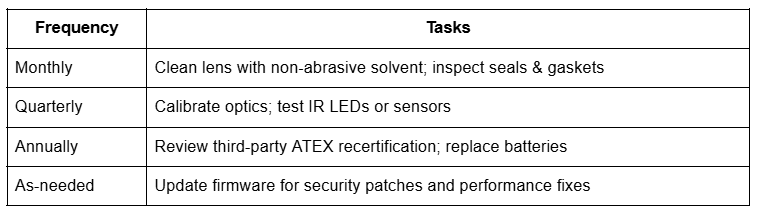
Common Pitfalls
- Using silicone cleaners degrades seals.
- Mounting near vibrating pipe flanges leads to distortion.
- Altering housing without recertification risks violations.
ATEX or IECEx in the UAE and Saudi Arabia: What Site Owners Accept
ATEX is the European framework; IECEx is the international scheme built on the same IEC 60079 standards. In the UAE, the Fire and Life Safety Code and operator standards such as those of ADNOC and DEWA require certified equipment in classified zones, and IECEx is the certificate most often named in project specifications, with ATEX certificates widely accepted alongside it. Saudi operators reference IECEx and SASO alignment in the same way, and North American sites use UL, CSA and NEC instead. Manufacturers of ATEX cameras therefore usually carry both ATEX and IECEx certificates. Name the scheme in the purchase order and reject photocopied or partial certificates.
Four mistakes void a certificate in practice: assuming one certificate covers every zone (it covers only the zones on the marking), charging or opening a unit inside the hazardous area, fitting accessories, glands or cables rated for a different zone, and ignoring the temperature class of the process. Each is a finding at audit and, after an incident, a liability.
Buyer checklist for an ATEX rated camera
- Zone: gas Zone 0, 1 or 2, or dust Zone 20, 21 or 22, taken from the area classification drawing.
- Gas group: IIA, IIB or IIC, matched to the substances on site.
- Temperature class: below the autoignition temperature of the process.
- Housing and IP rating: IP66 or higher, with corrosion protection offshore.
- Certificate verification: check the certificate number with the issuing body before the order is placed.
Top ATEX Camera Brands: Models & Price Comparison
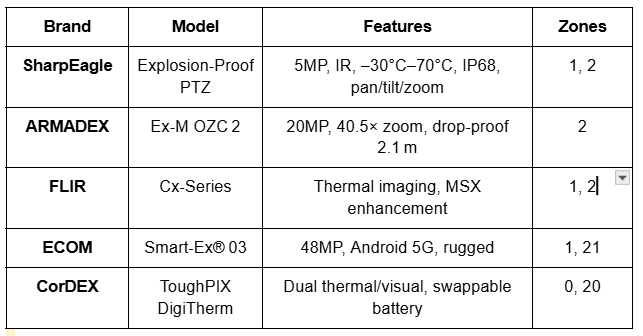
SharpEagle’s ATEX Camera Series & Use Cases
SharpEagle offers a wide range of ATEX-certified cameras designed for different industrial applications, from fixed monitoring in high-risk areas to mobile inspection in confined spaces. Each series is built to withstand hazardous environments while delivering clear imaging and reliable performance. Here’s an overview of the main product categories and where they excel:
Explosion‑Proof Mini IR Camera
- Compact stainless steel 304/316L.
- Zone 1/2 rated, IP68, –30°C to +70 °C.
- 1080p/5MP progressive CMOS, 3D noise reduction, Wi‑Fi/3G, ONVIF.
Explosion‑Proof PTZ Camera
- Full pan/tilt/zoom, IR-enabled.
- Hardened chassis in 316L.
- Zone 1/2, IP68, stainless steel; heavy-duty design.
Fixed Type Dome Camera
- Compact, vandal-resistant metal dome or bullet styles.
- Auto LED activation is used for surveillance in tight spaces.
- IP‑rated and explosion-proof certified.
Explosion‑Proof Digital Camera (Portable)
- Shock-proof (2.4 m drop), waterproof (30 m), freeze-proof to –10 °C.
- 5× optical + 4× intelligent zoom, explosion-proof flash.
SharpEagle's Business Model & After‑Sales Advantage
Full Lifecycle Support
From consultancy and design to deployment and after-sales, SharpEagle offers turnkey solutions. Their team includes technical and operations leads who provide 24/7 support.
Warranty & Certification
Two-year warranty and recertification support preserve long-term compliance. Product lines are certified per ATEX/IECEx, adding trust in procurement decisions.
Strategic Global Reach
UK-based, with hubs across MENA and India. Recognized globally for export excellence.
Procurement & Compliance: A Checklist
- Conduct a zone risk assessment.
- Demand certification evidence: ATEX/IECEx notations.
- Ask for third-party validation & safety performance documents.
- Evaluate after-sales, parts availability, and local service.
- Use formal tendering: include spec checklist, site conditions, maintenance terms, and warranty clauses.
SharpEagle Technology offers advanced ATEX Explosion Proof Camera Solutions across the UAE, Saudi Arabia, Oman, Kuwait, Bahrain, and Qatar. Built for the most demanding and hazardous environments, our solutions ensure uncompromised safety, reliable performance, and adherence to global compliance standards. With an expanding international presence, we empower industries worldwide with intelligent and future-ready monitoring systems.
Future Trends in ATEX Camera Tech
- AI Gas Detection: Edge analytics to flag leaks in real time.
- 5G Remote Monitoring: Faster streams for inspections and diagnostics.
- Cyber-Secure Firmware: Hardened to resist attacks.
- Smaller & Lighter Housing: INTRINSICALLY SAFE SIMPLIFICATION.
Conclusion: Safety Through Compliance & Innovation
ATEX-certified cameras are critical safety infrastructure, centerpieces in preventing disaster and ensuring regulatory compliance. SharpEagle stands out as a full-service partner: providing certified products, global reach, local support, and an innovative culture. Whether retrofitting with housings or deploying infrared PTZ systems, your choice of camera directly impacts plant resilience and worker safety.
Before you buy:
- Confirm hazard zones.
- Verify full certification.
- Compare manufacturer support.
- Factor in long-term maintenance.
Stay compliant, stay safe. Your investment protects both life and process continuity across the UK, UAE, KSA, and beyond.
Talk to SharpEagle’s ATEX experts today for tailored camera solutions that ensure compliance, protect your workforce, and keep operations running without risk.
